
How to Read a Garage
Certificate of Insurance
The complete ACORD 30 breakdown — every section explained with expert tips, red flags, and annotated visuals. Written by a licensed agent with 12+ years of garage insurance experience.
Download the PDF Guide
Get the full annotated ACORD 30 guide as a PDF — perfect for printing or sharing with your team.
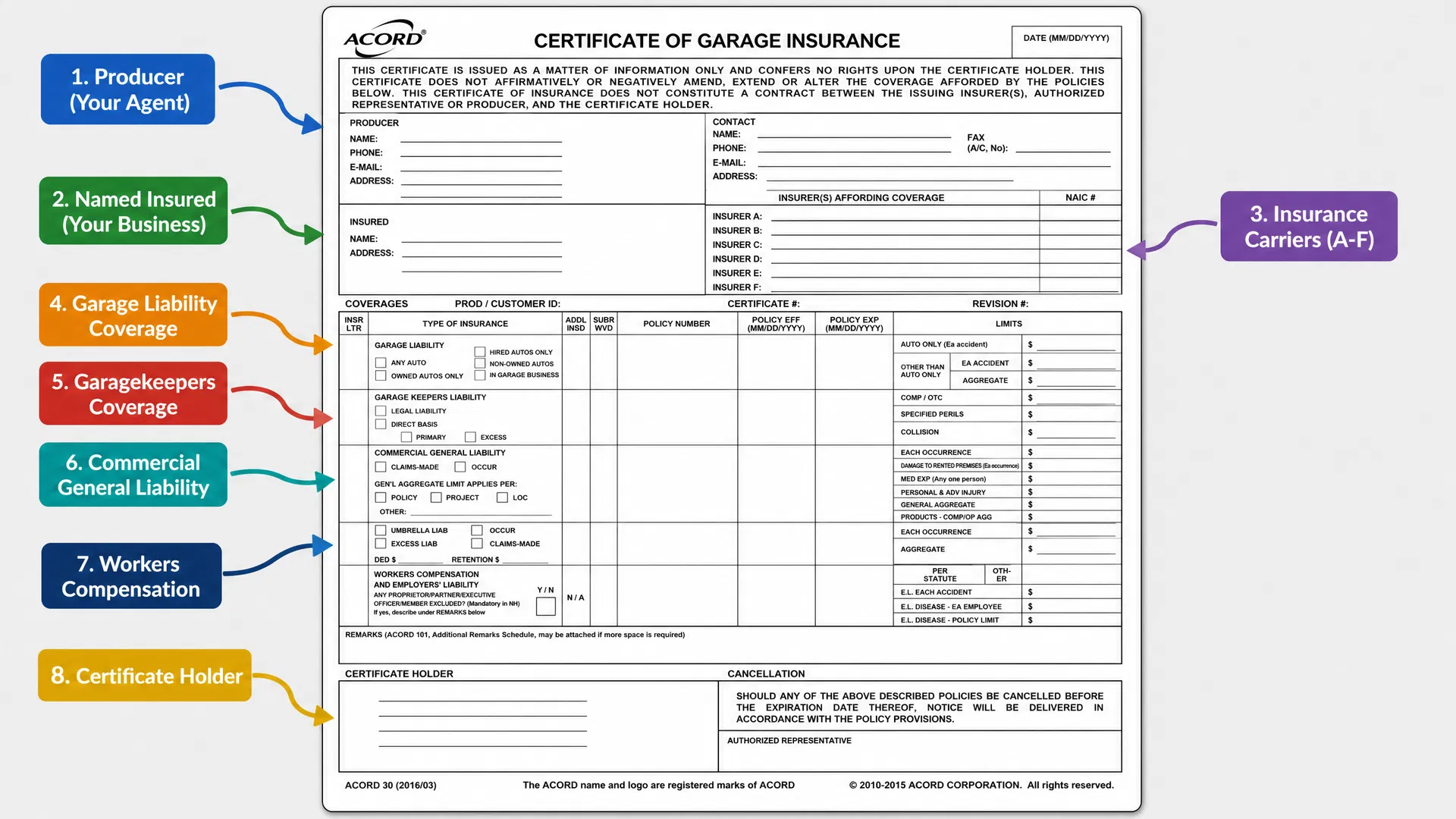
The ACORD 30 is the standard form used to prove a garage business has insurance. It is not a contract — it's a snapshot of coverage at a point in time. The form has 8 key sections: Producer (your agent), Named Insured (your business), Carriers (insurance companies), Garage Liability (auto + premises liability), Garagekeepers (damage to customers' cars), CGL (general liability), Workers' Comp (employee injuries), and Certificate Holder (who requested the cert). Click any section below for a deep dive.
Visual Breakdown
Annotated Certificate Overview
Each numbered section corresponds to a detailed breakdown below. Click any section to jump to its explanation.
Deep Dive
Section-by-Section Breakdown
Click each section to expand the full explanation with expert tips and red flags to watch for.
Must-Know
Key Concepts Every Dealer Should Understand
Certificate ≠ Contract
A certificate of insurance is informational only. It does not amend, extend, or alter the actual policy. If there's a conflict between what the certificate shows and what the policy says, the policy always wins. Never rely solely on a certificate — request the actual declarations page and endorsements for critical coverage verification.
Additional Insured vs. Certificate Holder
Being named as a Certificate Holder gives you no coverage rights — you simply receive proof that insurance exists and get notified of cancellation. Being named as an Additional Insured actually extends coverage to you under the policy, but requires a formal endorsement. A checkmark on the ADDL INSD box should always be backed by an actual endorsement on the policy.
Garage Liability vs. Garagekeepers
Garage Liability covers your liability to others (bodily injury and property damage you cause). Garagekeepers covers damage to customers' vehicles in your care. Think of it this way: Garage Liability pays when you hurt someone else or damage their property through your operations. Garagekeepers pays when a customer's car gets damaged while you have it.
Legal Liability vs. Direct Primary
For Garagekeepers coverage, Legal Liability only pays when you're at fault. Direct Primary pays regardless of fault. If a hailstorm damages 20 customer vehicles on your lot, Legal Liability won't cover it (you didn't cause the hail). Direct Primary will. The cost difference is typically 15-25% more premium, but the protection difference is enormous.
Comparison
ACORD 30 vs. ACORD 25: What's the Difference?
The ACORD 25 (Certificate of Liability Insurance) is the general-purpose certificate used by most businesses. The ACORD 30 (Certificate of Garage Insurance) is specifically designed for garage operations. Here's how they compare:
| Feature | ACORD 25 | ACORD 30 |
|---|---|---|
| Primary Use | General businesses | Auto dealers, repair shops, service stations |
| Garage Liability Section | ❌ Not included | ✅ Dedicated section with auto type checkboxes |
| Garagekeepers Section | ❌ Not included | ✅ Legal Liability / Direct Basis / Primary / Excess |
| Commercial Auto Section | ✅ Standard auto liability | ❌ Replaced by Garage Liability |
| CGL Section | ✅ Always included | ✅ Optional (may be part of Garage form) |
| Workers' Comp | ✅ Included | ✅ Included |
| When to Use | Non-garage businesses | Any business with garage operations as primary activity |
Avoid These
Common Mistakes When Reading a Garage Certificate
Assuming the certificate guarantees coverage
The certificate is a snapshot, not a promise. Policies can be cancelled, limits can be exhausted by prior claims, and exclusions may apply that aren't shown on the certificate. Always request the actual policy documents for critical decisions.
Not checking policy dates
An expired certificate is worthless. Always verify that the Policy Effective and Policy Expiration dates (MM/DD/YYYY) show current, active coverage. Set calendar reminders 30 days before expiration to request updated certificates.
Confusing Garage Liability limits with Garagekeepers limits
Garage Liability limits (e.g., $1M CSL) cover your liability to third parties. Garagekeepers limits (e.g., $100K LOC) cover damage to individual customer vehicles. A $1M Garage Liability limit does NOT mean you have $1M of coverage per customer vehicle.
Ignoring the 'Legal Liability' vs. 'Direct' distinction
Many dealers don't realize their Garagekeepers is 'Legal Liability Only' until a claim is denied. If a customer's car is damaged by hail, vandalism, or theft on your lot and you have Legal Liability only, the claim will be denied because you weren't at fault.
Not verifying the carrier's financial strength
A certificate from a financially weak carrier is a false sense of security. Use the NAIC number to check the carrier's AM Best rating. If the carrier goes insolvent, claims may go unpaid — especially with non-admitted/surplus lines carriers not covered by state guaranty funds.
Sources & References
ACORD Corporation — Forms Instruction Guide, ACORD 30 (2016/03). acord.org
Insurance Information Institute (III) — Understanding Your Insurance Policy, 2023. iii.org
International Risk Management Institute (IRMI) — Garage Coverage Forms, 2024. irmi.com
Florida Statutes — § 320.27(3) Motor Vehicle Dealer Requirements; § 440.02 Workers' Compensation; § 624.408 Capital and Surplus Requirements. leg.state.fl.us
National Association of Insurance Commissioners (NAIC) — Certificate of Insurance Model Act, 2013. naic.org
Texas Department of Insurance (TDI) — Approved Certificate Forms. tdi.texas.gov
Need Help Understanding Your Certificate?
Our team specializes in garage and dealer insurance. We can review your current certificate, identify coverage gaps, and ensure your limits meet your lender and state requirements.
Disclaimer: This guide is provided for educational purposes only and does not constitute legal or insurance advice. Insurance policies, state regulations, and ACORD form versions may change. Always consult with a licensed insurance professional and review your actual policy documents for coverage verification. The information presented here is accurate as of July 2026 but should be independently verified for your specific situation and jurisdiction.