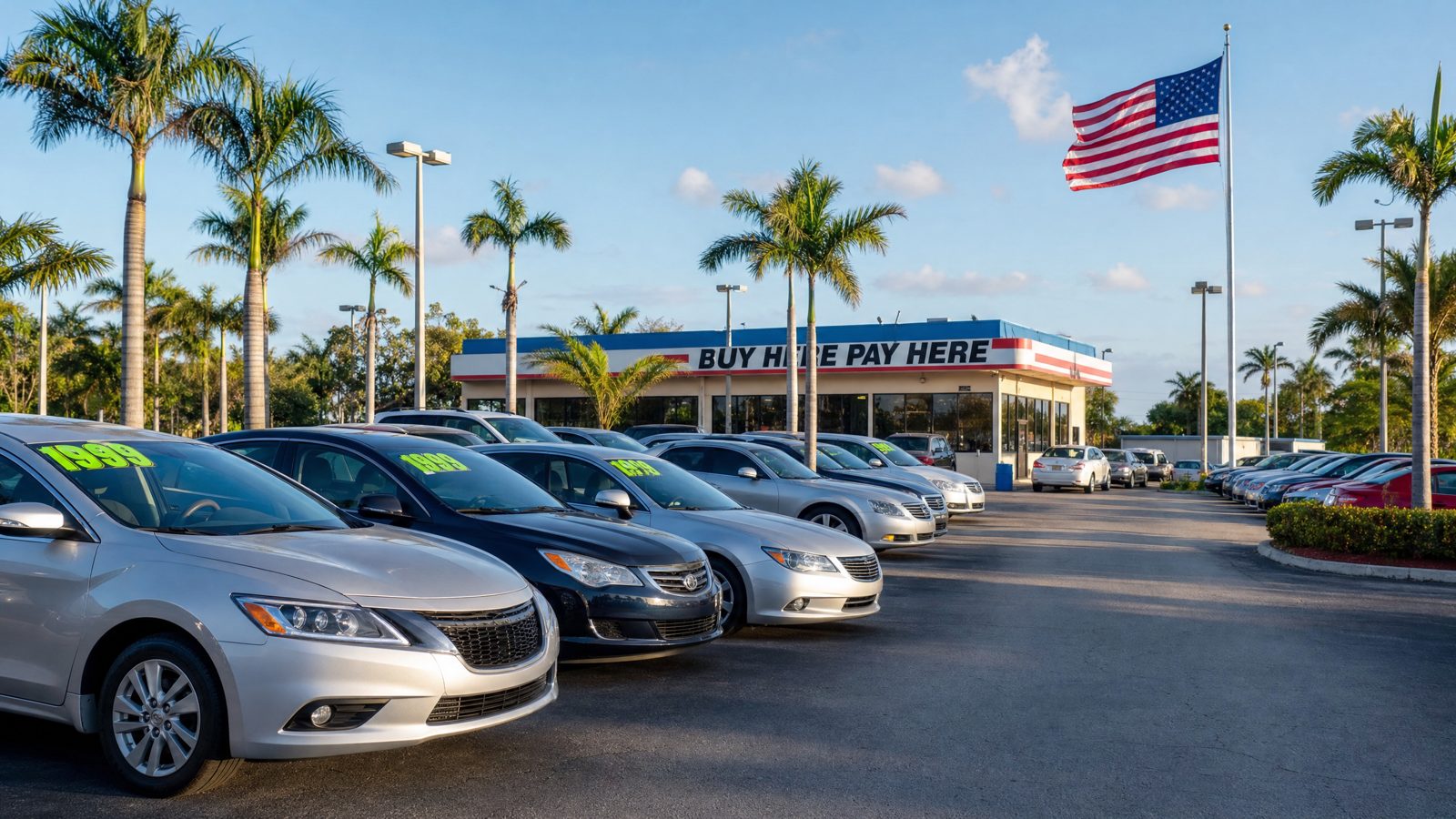
When you run a Buy Here Pay Here dealership, you are not just selling cars — you are the bank. That single fact changes everything about the insurance you need. A standard garage liability policy alone will leave your loan portfolio, your collateral, and your cash flow dangerously exposed.
Operating a Buy Here Pay Here (BHPH) dealership is fundamentally different from running a traditional retail used car lot. In a standard dealership, a third-party bank or credit union assumes the financing risk once the vehicle rolls off the lot — you get paid up front and the loan default isn't your problem. In the BHPH model, you carry the note, you depend on customer repayment, and you absorb the loss if a buyer defaults or totals an uninsured vehicle.
Because you are both the retailer and the lender, your insurance needs are significantly more complex. This comprehensive 2026 guide breaks down the exact coverages BHPH dealers need to protect their inventory, their collateral, and their bottom line — and the policies most generalist agents never mention.
Why BHPH Dealers Need Different Insurance
Buy Here Pay Here dealerships cater to credit-challenged buyers who often struggle to maintain traditional, full-coverage auto insurance. This creates a dangerous gap. If a customer drives off your lot and totals the vehicle two weeks later without active insurance, they will frequently stop making payments. As the lienholder, you are left with a destroyed asset and an uncollectible loan.
Layered on top of that is repossession. BHPH dealers handle repossessions — either directly or through third-party recovery agents — and repossession is a high-liability activity that regularly produces claims of wrongful repossession, damage to the debtor's personal property, and bodily injury. Standard commercial auto and general liability policies routinely exclude these specific risks.
The Three Phases of BHPH Risk
To build a program that actually protects a Buy Here Pay Here operation, it helps to think about the three distinct phases every vehicle in your business moves through. Each phase has its own exposures and its own corresponding coverage.
| Phase | Where the Vehicle Is | Primary Coverage |
|---|---|---|
| 1. On the Lot | Inventory waiting to be sold | Dealers Open Lot (DOL) |
| 2. On the Road | Financed & being paid off by the buyer | CPI / VSI (collateral protection) |
| 3. In Recovery | Being repossessed or held post-repo | Repossession liability & skip coverage |
Core Coverages Every BHPH Dealer Must Have
Every dealership's exact needs vary by inventory size, state regulations, and whether you perform in-house reconditioning. But the following coverages form the foundation of a solid BHPH insurance program.
Garage Liability
The cornerstone policy — combines general and auto liability for premises, operations, completed work, and dealer-driven vehicles.
Dealers Open Lot
Physical-damage protection for unsold inventory against hail, wind, flood, fire, theft, vandalism, and collision.
CPI / VSI
Protects your financial interest in financed vehicles when the buyer lets their own insurance lapse.
Repossession Liability
Covers wrongful-repo, personal-effects, and bodily-injury claims that standard policies exclude.
Cyber Liability
Shields you after a data breach — critical under the FTC Safeguards Rule for dealers holding SSNs and credit data.
Dealer Surety Bond
The mandatory license bond protecting the public from fraud, unpaid taxes, or title failures.
1. Garage Liability Insurance
Garage liability is the cornerstone of any auto dealer's portfolio. It combines elements of general liability and commercial auto liability into a single policy designed specifically for automotive businesses. For a BHPH dealer it covers premises liability (a slip-and-fall on your lot), operations liability, products and completed operations (if you recondition vehicles before sale), and auto liability for dealership-owned vehicles during test drives or errands.
2. Dealers Open Lot (DOL) Coverage
Dealers Open Lot insurance — also called inventory coverage — protects your vehicles while they sit on your lot waiting to be sold. It covers physical damage from weather (hail, wind, flood, lightning), fire, theft, vandalism, and collision. When structuring DOL, you must accurately report your maximum inventory value. Being underinsured can trigger a co-insurance penalty, meaning the carrier pays only a fraction of your claim if your true inventory value exceeded your limit at the time of loss.

3. Collateral Protection: CPI and VSI
This is where BHPH insurance diverges sharply from traditional dealer insurance. Because you are the lienholder, you must protect your financial interest in the vehicle after it leaves the lot. If a buyer drops their insurance and totals the car, two products serve as your safety net — and dealers frequently confuse them.
Collateral Protection Insurance (CPI)
CPI is a force-placed policy applied to a single vehicle. When a BHPH customer fails to maintain the comprehensive and collision coverage required in their contract, the dealership (or its servicing company) places CPI on that specific vehicle and adds the premium to the customer's loan balance. CPI protects the lender's interest in the collateral up to the outstanding loan amount.
Vendor Single Interest (VSI) Insurance
VSI is a blanket policy purchased by the dealership that covers the entire loan portfolio at once. Rather than tracking and force-placing coverage car by car, VSI protects the lender across all financed accounts against uninsured physical damage, theft, and other recovery losses.
| Feature | CPI (Force-Placed) | VSI / Blanket LSI |
|---|---|---|
| Applies to | Individual uninsured vehicle | Entire loan portfolio |
| Triggered when | Borrower's insurance lapses | Always active across all loans |
| Admin burden | High — must track each policy | Low — no individual tracking |
| Typical cost basis | Added to specific loan balance | Per vehicle financed (often passable to buyer) |
| Best for | Dealers wanting buyer to bear cost | High-volume BHPH portfolios |
A typical VSI policy can include collateral physical damage (uninsured damage or theft), skip coverage (when a borrower disappears with the vehicle), repossession damage discovered after recovery, and instrument non-filing coverage for losses caused by lien-recording errors. Many BHPH dealers prefer blanket VSI because it eliminates the administrative grind of force-placing CPI case by case, and in many states the cost can be legally disclosed and passed on to the borrower as part of the amount financed.
4. Repossession Liability Coverage
Repossession is an inherent part of the BHPH business model, and the liability exposure is immense. Claims of assault, battery, trespassing, breach of the peace, and damage to the debtor's personal property are common. Standard garage liability policies often contain a repossession exclusion.
If you handle repossessions in-house, you need an endorsement or separate policy specifically covering repossession operations, including wrongful repo and personal-effects coverage. If you use third-party recovery agents, require them to carry their own robust repossession insurance and name your dealership as an Additional Insured — but don't assume that fully shields you. Courts frequently hold the lienholder vicariously liable for the actions of hired agents, so contingent liability coverage is strongly recommended.
5. Cyber Liability Insurance
BHPH dealers collect and store enormous volumes of sensitive consumer data: Social Security numbers, credit reports, bank details, and payment histories. That makes your dealership a prime target. Cyber liability insurance covers breach notification, credit monitoring, regulatory fines, and legal defense. With the FTC's Safeguards Rule imposing strict data-security obligations on auto dealers, cyber coverage has moved from optional to essential.
6. Dealer Surety Bonds
While not technically insurance, a motor vehicle dealer surety bond is a mandatory requirement to obtain and keep your dealer license in nearly every state. The bond protects the public and the state against fraud, misrepresentation, or failure to remit sales tax and title fees. Because BHPH dealers handle financing and titles directly, regulators often view them as higher-risk — so a clean compliance record is key to keeping bond premiums affordable.
Not Sure Your BHPH Program Has These Gaps Covered?
As an independent agency with deep experience in dealer and garage risks, we have access to 100+ A-rated carriers and compare eligible markets to build a complete BHPH program — garage liability, open lot, CPI/VSI, and repossession coverage in one place.
How Much Does BHPH Insurance Cost?
Insurance costs for Buy Here Pay Here dealerships vary widely based on location, inventory size, claims history, and the specific coverages selected. Because of the added financing and repossession exposures, BHPH dealers generally pay more than traditional retail used car lots. The figures below are illustrative 2026 ranges for a mid-sized operation — your actual premium depends on your specific risk profile and state.
| Coverage | Illustrative Annual Range | Primary Cost Drivers |
|---|---|---|
| Garage Liability | $3,500 – $8,000+ | Revenue, payroll, claims history, # of dealer-driven units |
| Dealers Open Lot | $2,000 – $6,000+ | Total inventory value, weather/catastrophe exposure |
| VSI / Blanket LSI | ~$50 – $100 per loan | Loan volume, average amount financed |
| Cyber Liability | $1,000 – $2,500 | Records stored, security controls in place |
The most effective way to control these costs is operational, not just transactional: implement strict borrower underwriting, keep your lot secure and well-lit to deter theft, and maintain rigorous compliance and repossession protocols. Carriers reward disciplined operators with better terms.
Compliance & Risk Management Best Practices
Insurance is your safety net, but proactive risk management is your first line of defense. The most successful BHPH operators manage their portfolio like a bank — not just a car lot.
- Tighten underwriting standards. A solid down payment is the single best predictor of loan performance. Verify income, residence stability, and employment history. Cash invested equals commitment from the buyer.
- Use GPS and starter-interrupt technology. Where legally permitted, these devices dramatically reduce skips and make recovery safer. Many VSI and CPI carriers offer premium discounts to dealers who use them.
- Maintain impeccable documentation. Ensure retail installment contracts are compliant, clearly state insurance requirements, and include proper disclosures on repossession and force-placed coverage.
- Monitor delinquency aggressively. Track 30- and 60-day delinquency and charge-off ratios. Early warning signs ignored will compound quickly into portfolio losses.
Frequently Asked Questions
Do Buy Here Pay Here dealers legally have to carry insurance?
What's the difference between CPI and the buyer's "full coverage"?
Is VSI better than CPI for my dealership?
Does garage liability cover repossessions?
Will a single uninsured total loss really hurt my business?
Disclaimer: This article is provided for general informational purposes only and does not constitute legal, financial, or insurance advice, nor a recommendation of any specific carrier or product. Coverage availability, pricing, regulatory requirements (including FTC Safeguards Rule obligations and state collateral-protection disclosure rules), and policy terms vary by state and risk profile and are subject to change. Cost ranges shown are illustrative estimates, not quotes. Always work with a licensed insurance agent and confirm current requirements with your state's licensing authority before binding coverage. Information last verified June 2026. DealerLiability.com is a division of Ellie Insurance Group and is not a law firm.

Kevin A. Smith
Kevin specializes in commercial insurance for automotive businesses — dealers, repair shops, towing companies, and garages — across FL, TX, GA, NC, SC, OK, NM, and UT. He works with 100+ A-rated carriers to find the right coverage at the right price.
View all articles by Kevin