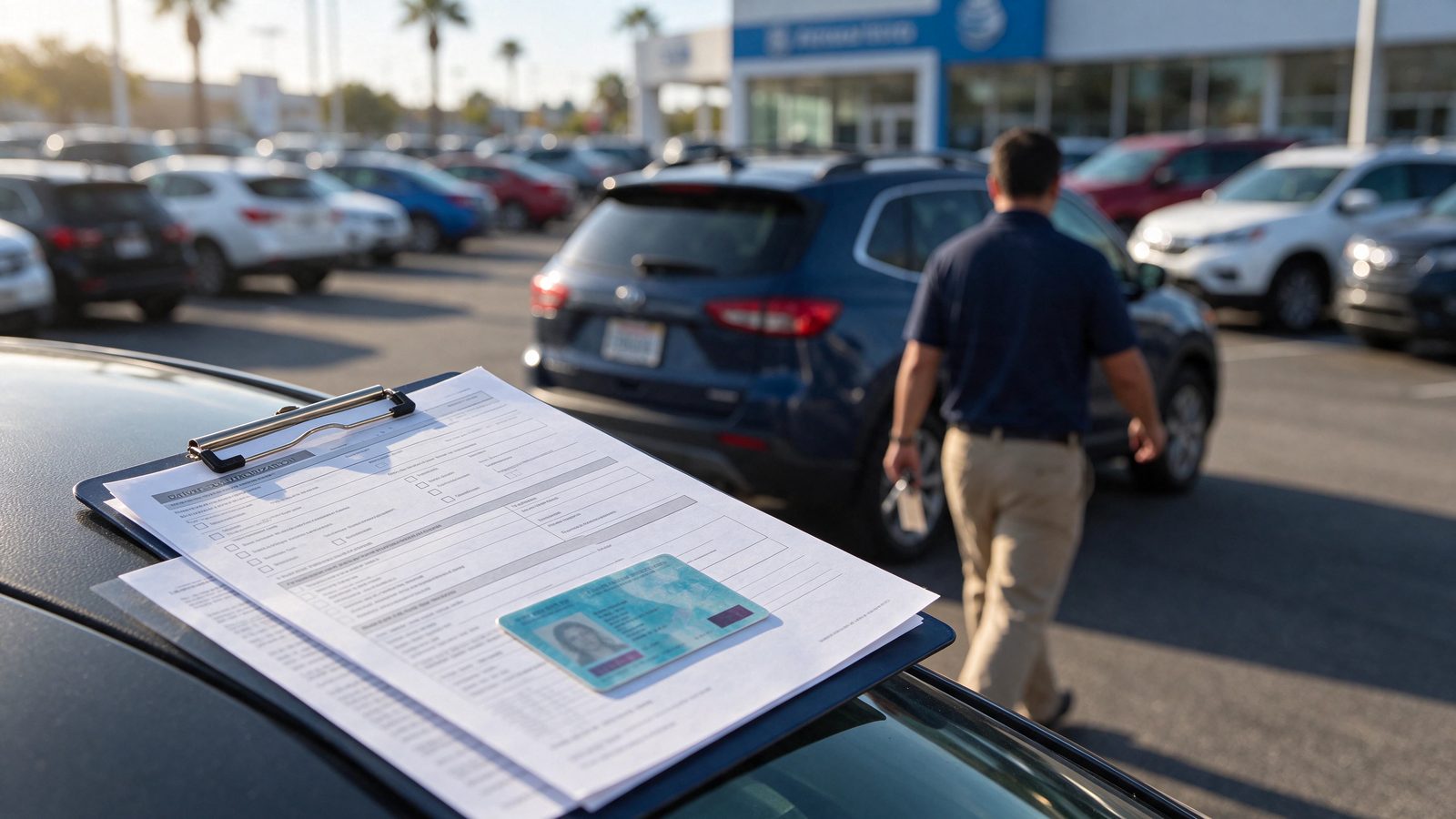
The most dangerous liability exposure at a used car dealership is not on the lot. It is behind the wheel: the porter running a car to the detail shop, the salesperson taking a demo home, the technician road-testing a customer's truck, and the service customer in your loaner. When one of those drivers hurts someone, the first question a plaintiff's attorney asks is what you knew about that driver before you handed over the keys. This guide covers which drivers need screening, how to pull motor vehicle records (MVRs) legally, what a written driving standard looks like, and the paperwork that decides who pays after a crash.
Why driver screening is an insurance issue
Zurich, a major dealer insurer, published this as an actual large loss in 2025. A dealership technician took a vehicle home overnight for an extended maintenance check. The next morning he was driving more than 20 mph over the speed limit, crossed into the other lane, and caused a head-on collision that killed another driver. His driving history showed four prior accidents and six speeding violations.[1]
That is the setup for a negligent entrustment claim. Zurich defines it as trusting someone with a dangerous instrument while knowing they might use it in a risky manner, and gives a dealer example: an employee with an unsafe driving history allowed to drive a company vehicle who then has an accident. Zurich also describes negligent hiring (harm that pre-employment screening would have prevented) and negligent retention (keeping an employee you knew or should have known was a danger).[1]
The Texas Independent Automobile Dealers Association (TIADA) says it often hears from member dealers who have been "threatened with a lawsuit, or actually sued" over crashes caused by their uninsured customers. Its general counsel explains that negligent entrustment can create liability when a dealer turns a vehicle over to someone it knows, or should know, is an unsafe driver, and that "anyone without a driver's license is presumed to be an unsafe driver."[2] That discussion is Texas-specific, but the principle shows up across states: the less you checked, the harder you are to defend.
Driver quality also shows up in your premium. In a 2026 Facebook thread where Georgia dealers compared garage insurance prices, an insurance commenter pointed to MVRs, credit, and years in business as pricing factors.[3] That is one commenter's view, not a rating manual, but underwriters do look at who drives your cars.
Who belongs on your driver list
Zurich recommends checking MVRs for every employee who drives company or customer vehicles as part of their regular job duties.[1] At a used dealership, that list is usually longer than the owner expects:
- Porters and lot attendants who move inventory, shuttle cars to recon, and run to the auction.
- Salespeople who ride along on test drives, deliver vehicles, or drive demos.
- Technicians and detailers who road-test, move, or take vehicles off site.
- Managers and owners with take-home demos, and anyone in their household who drives those demos.
- Part-time and contract drivers, including drivers you pay to pick up auction purchases.
- Service customers in loaners, if you offer them. Test-drive customers are covered in our unaccompanied test-drive guide.
If someone is not on the list, they do not drive. That one rule prevents the most common gap: the new hire who moves cars on day one before anyone has checked a record.
How to pull MVRs legally
There are two common ways to get a driving record, and each comes with its own rules.
Path 1: through a background screening company. When you get a report from a company in the business of compiling background information, it is a consumer report, and the Fair Credit Reporting Act (FCRA) applies whenever you use it for hiring, retention, promotion, or reassignment. FTC staff have stated that "driving record checks and criminal record checks are covered by the FCRA" when a consumer reporting agency provides them to an employer.[4] The Federal Trade Commission lists the required steps:[5]
- Disclose in writing, on its own page. Tell the applicant or employee you may use the report for employment decisions. The notice must be a stand-alone document, not part of the job application.
- Get written permission. If you want to re-run reports throughout employment, the authorization must say so clearly and conspicuously.
- Certify compliance to the screening company.
- Before an adverse action, such as not hiring someone or taking away driving duties based on the report, give the person a copy of the report and "A Summary of Your Rights Under the Fair Credit Reporting Act."
- After the adverse action, give an adverse action notice with the screening company's contact information, a statement that the company did not make the decision, and the person's right to dispute the report.
- Dispose of reports securely when you are done with them.
The FTC also suggests reviewing your state's laws, because some states restrict how employers use consumer reports.[5]
Path 2: directly from the state. Driver records are protected by the federal Driver's Privacy Protection Act (DPPA). One permitted use is "for use by any requester, if the requester demonstrates it has obtained the written consent of the individual to whom the information pertains."[6] In Florida, anyone can check whether a license is valid for free through the state's online Driver License Check. Drivers can buy their own three-year, seven-year, or complete record through the MyDMV Portal, a service center, a clerk of court, or a private vendor, and another person's record can be requested by mail with Form 90511, subject to DPPA protections. The three- and seven-year records show guilty traffic dispositions in that period, crash entries tied to a citation, and all open suspensions and revocations.[7] Other states have their own request processes and fees.
Your insurer may also review your drivers' records when it rates or underwrites your policy. DPPA separately permits insurers to use driver records for claims, antifraud, rating, and underwriting.[6] That is another reason to give your agent an accurate driver list. A driver the carrier has never seen is a surprise nobody wants after a claim.
Set a written driving standard
An MVR is only useful if you decide in advance what disqualifies someone. Write the standard down, apply it to everyone the same way, and ask your agent whether your carrier has its own driver guidelines, because the carrier's rules may be stricter than yours. The table below is an example to adapt, not a rule from any carrier or regulator.
| Record item | Example standard to discuss with your carrier |
|---|---|
| License status | Must be valid. No driving while suspended, revoked, or expired. |
| DUI or reckless driving | Not approved to drive dealer or customer vehicles within a set number of years |
| Moving violations | A maximum number in the past three years before the driver is reviewed or restricted |
| At-fault accidents | A maximum number in the past three years before review |
| Experience | A minimum years licensed, or a road test for newer drivers |
| Road test | Required for anyone who drives as a regular part of the job, as Zurich recommends |
Zurich also recommends a road test for applicants who will drive as part of their job, a post-offer physical for roles like parts drivers who lift heavy items, and an alcohol and drug screen before anyone goes behind the wheel.[1] Check your state's rules on testing before you add it.
Re-check, train, and act on violations
A clean record at hire does not stay clean on its own. Zurich recommends checking MVRs regularly to make sure employees drive safely outside work too, running driver safety training for employees who regularly drive company vehicles (it suggests every six months), and having employees sign an acknowledgement that they will follow your policies. When a violation turns up, Zurich says to take disciplinary action, which may include taking away driving privileges.[1]
A workable rhythm for a small lot:
- At hire: consent, MVR, road test, signed driver policy, and added to the driver list you give your agent.
- At least once a year, and before renewal: re-run MVRs for everyone on the list so your renewal reflects the drivers you actually have. If you use a screening company, make sure your authorization covers ongoing checks.
- Every six months: a short driver safety refresher for regular drivers.
- Anytime: employees report any ticket, accident, or license action within a set number of days, in writing.
Document what you do about a bad record. Zurich warns that negligent retention claims come from keeping an employee you knew, or should have known, posed a danger.[1] An MVR showing a problem, with no action taken, can be worse than no MVR at all.
Take-home demos and dealer plates
The Zurich loss started with a vehicle taken home overnight.[1] Take-home use is where screening, plate rules, and coverage collide, and dealers admit it gets loose. On Reddit, a dealership staffer wrote, "I've used my dealer plate on my personal vehicle for almost 4 weeks," in a thread full of staff describing lost and misused plates.[8] In a 2023 r/legaladvice post, the other party in a Florida crash alleged that a dealership employee had been using a dealer plate on his own car and that the dealer's insurer denied the claim. That is one side's unverified account, but it shows how plate misuse turns into a coverage fight.[9]
A take-home policy should answer five questions in writing:
- Who can take a vehicle home, and who approves it?
- Can anyone else, such as a spouse or teenager, drive it? If yes, they go through the same screening and onto the driver list.
- What uses are allowed: commuting only, or personal errands and trips?
- Which plate goes on the vehicle, and is it logged out and back in?
- Which vehicles can never carry a dealer plate? Personal vehicles belong on that list. Follow your state's plate-use rules.
Then ask your agent whether your garage policy covers each of those uses, including household members. Our dealer plate insurance guide covers state plate rules in detail.
Service loaners: the paperwork matters
If you run a service department and lend cars, the loaner handoff is a driver-screening moment. Federated Insurance described a dealership employee who was in a hurry and released a service loaner without verifying the customer's license or insurance. The customer crashed into another vehicle and injured two people, for "$350,000 in total damages." Federated's suggestions include copying the customer's valid license and proof of insurance, naming one person who authorizes loaners, limiting loaners to drivers 25 and older, and using a signed loaner agreement that limits who can drive and sets the radius and duration.[10]
In Florida, that paperwork carries extra weight. Florida law says a dealer that lends a temporary replacement vehicle to a service customer whose car is in for repair may not be held liable without negligence or criminal wrongdoing by the dealer, if the dealer signs a written rental or use agreement with the customer and gets a copy of the customer's driver's license and insurance information showing at least Florida's minimum coverage. If the license or insurance later turns out to be fake or canceled, the protection still applies unless the dealer knew at the time.[11] It does not protect a dealer from its own negligence, such as handing a loaner to someone it knows is unsafe to drive.
The paperwork also shapes whose insurance pays. In a 2020 Tennessee appeals case involving a franchise dealership, a service customer signed a rental agreement for one loaner, then swapped to an SUV, with the vehicle number changed on his copy. He caused a crash, and a jury awarded the injured driver and his wife $275,000 and $50,000. The jury found the dealership not liable and found the customer was not on a test drive. The court then held that, as a driver under a written rental agreement, the customer was not an insured under the policies covering the dealership, so the injured couple could not collect the judgment from those policies.[12] The lesson for dealers: whether a drive is a loaner, a rental, or a test drive changes how your policy responds. Label it correctly and have your agent review your loaner agreement.
The driver file checklist
Keep one file per driver. If a crash ever turns into a lawsuit, this file is what shows you did your homework.
| Document | When |
|---|---|
| Signed consent (FCRA disclosure and authorization, or DPPA written consent) | Before the first record check |
| MVR with date pulled | At hire, then at least annually |
| Copy of license with expiration date | At hire, and at each renewal of the license |
| Road test result | Before regular driving duties |
| Signed driver policy (standards, take-home, plates, phone use, reporting tickets) | At hire, and when the policy changes |
| Training dates | Every six months for regular drivers |
| Approved uses (lot only, road, take-home, household drivers) | At hire and when duties change |
| Incidents and actions taken | Whenever they happen |
Store driver files securely and limit who can see them. They contain personal information, and the FTC requires secure disposal of consumer reports when you no longer need them.[5]
Make Sure Your Drivers and Your Policy Match
Ellie Insurance Group has access to 100+ A-rated carrier markets (AM Best A- or higher) and holds a 5-star Trusted Choice agency rating. Send us your driver list and declarations, and we will check how your garage liability handles employees, take-home demos, household drivers, and loaners, and compare eligible options.
Related reading: the 7 biggest insurance mistakes used car dealers make, test drive liability insurance for dealers, and garage liability insurance.
Driver screening FAQs
What is negligent entrustment for a car dealer?
It is a claim that you let someone drive your vehicle when you knew, or should have known, they were an unsafe driver. Zurich's dealer example is an employee with an unsafe driving history who is allowed to drive a company vehicle and then causes an accident. Checking MVRs and acting on what they show is the main defense.[1]
Do I need an employee's permission to check their driving record?
Get written permission either way. If you order the record through a background screening company, the FCRA requires a stand-alone written disclosure and written authorization, and FTC staff have said driving record checks from a consumer reporting agency are covered. If you request the record directly from the state, the DPPA permits disclosure with the driver's written consent.[5][4][6]
How often should a dealership check employee MVRs?
At hire and on a regular schedule after that. Zurich recommends checking MVRs regularly and training employees who regularly drive company vehicles every six months. Many dealers re-check at least once a year and before renewal so the policy reflects their actual drivers.[1]
Can a salesperson's spouse drive a take-home demo?
Only if your written policy allows it and your garage policy covers household drivers. Anyone allowed to drive a dealer vehicle should be screened the same way as employees and added to the driver list you give your agent. Ask your agent to confirm coverage before you allow it.
What should a dealer collect before handing over a service loaner?
A signed loaner agreement, a copy of the driver's valid license, and proof of insurance. Federated reported a $350,000 loaner claim after an employee skipped those checks. In Florida, a written rental or use agreement plus a copy of the customer's license and insurance information is also a condition of the dealer liability protection in section 324.021.[10][11]
Does a bad MVR affect my garage insurance premium?
Sources and references
Statutes, regulator guidance, insurer publications, and court opinions are cited as published. Reddit and Facebook posts are individual accounts and are labeled as anecdotal or unverified. Franchise dealer cases and state-specific rules are labeled as such. Your policy's terms control coverage.
- Zurich North America, Prevent claims of negligence at your dealership (March 3, 2025)
- TIADA, Does the Sale or Loan of a Vehicle Create Dealer Liability? (October 19, 2017)
- Facebook, Georgia Auto Dealers/Brokers group thread on what dealers pay (August 17, 2026), dealer self-reports
- FTC staff advisory opinion to Basting (June 11, 1998), driving record checks under the FCRA
- Federal Trade Commission, Using Consumer Reports: What Employers Need to Know (October 2016)
- 18 U.S.C. Section 2721, Driver's Privacy Protection Act permissible uses (Cornell LII)
- FLHSMV, Questions About Driving Records (3-year, 7-year, and complete records; DPPA)
- Reddit r/askcarsales, Cust drove off with dealer plate sitting on bumper (September 26, 2019), anecdotal forum thread
- Reddit r/legaladvice, third-party account of a dealer-plate misuse accident in Florida (December 17, 2023), unverified allegation
- Federated Insurance, Claim of the Month: verify license and insurance (PDF, circa May 2023)
- 2026 Florida Statutes, Section 324.021(9)(c)3., dealer temporary replacement vehicles
- Williams v. State Farm Mutual Automobile Insurance Co. (Tenn. Ct. App. Nov. 20, 2020)
Insurance, employment, and legal disclaimer: This article is general education for motor vehicle dealers, not legal advice or a promise of coverage. Background check, driving record, drug testing, and employment rules vary by state and change over time; consult an employment attorney before you adopt a screening process. Coverage for employees, household drivers, take-home vehicles, and loaners depends on your issued policy, endorsements, exclusions, and the facts of a loss. Dealer forum and social media posts describe individual experiences and may not be typical. Sources reviewed November 23, 2026.

Kevin A. Smith
Kevin specializes in commercial insurance for automotive businesses — dealers, repair shops, towing companies, and garages — across FL, TX, GA, NC, SC, OK, NM, and UT. He works with 100+ A-rated carriers to find the right coverage at the right price.
View all articles by Kevin