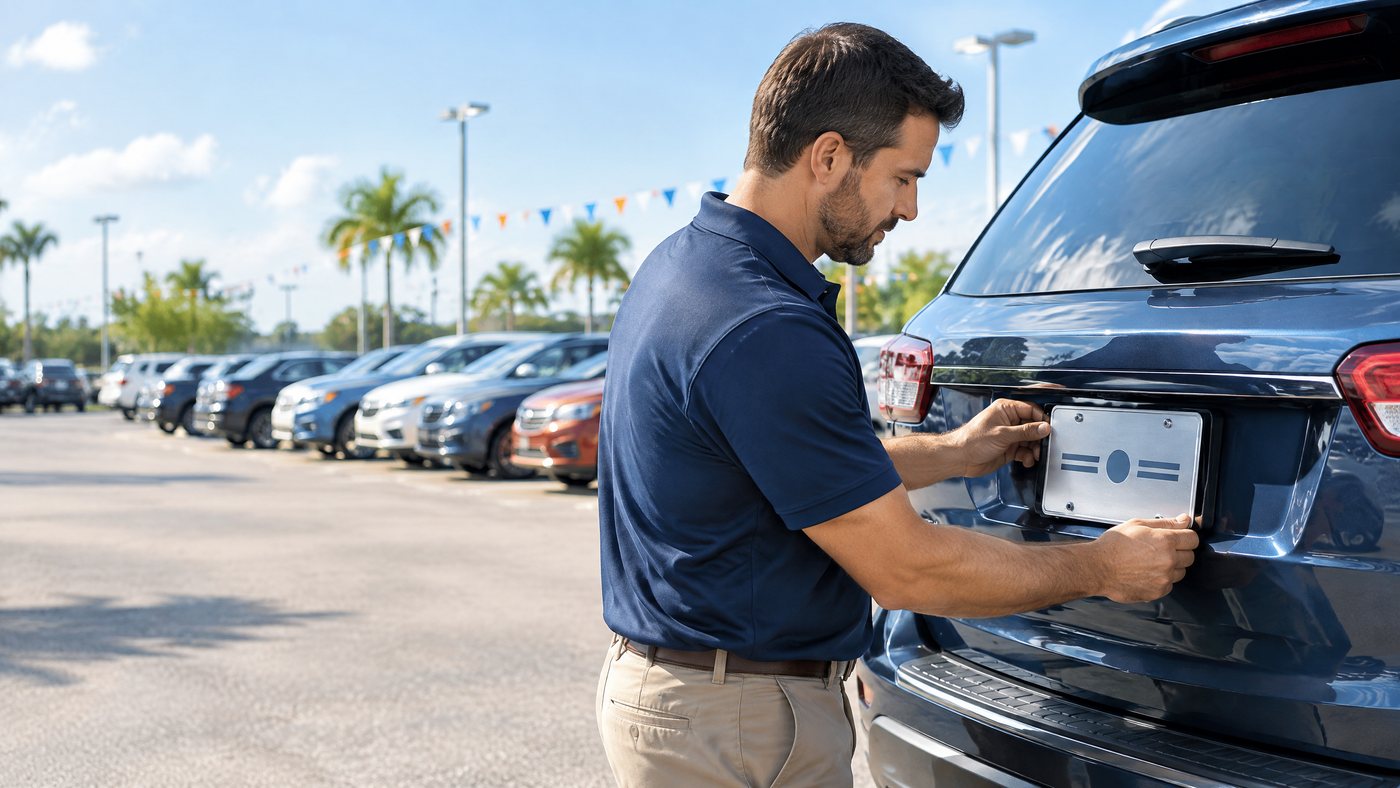
Dealer plates make a used-car dealership possible. They let a dealership legally road-test inventory, demonstrate vehicles to prospective buyers, move units for repairs or reconditioning, and perform other limited business activities without separately registering every vehicle on the lot. But the plate itself is not insurance, and it is not a universal pass that allows any person to drive any dealership-connected vehicle for any purpose.
That distinction matters because a single uncontrolled plate can create a severe auto liability claim, trigger a coverage dispute, increase renewal pricing, or jeopardize the dealership’s licensing privileges. State laws determine who may use a dealer plate and for what purpose. The dealership’s garage liability or business auto coverage determines whether a particular driver, vehicle, and use falls within the policy.
This guide explains what dealer plate insurance actually means, how coverage usually works, which uses create the greatest risk, how several major states regulate dealer tags, and what a used auto dealership should do before another employee, customer, contractor, or family member takes a plate off the premises.
Dealer plate insurance is generally not a separate policy that automatically follows a metal tag. The term commonly refers to liability protection within a dealer’s garage liability or business auto program for qualifying vehicles, drivers, and uses. The vehicle, driver, purpose, covered-auto symbols, endorsements, state law, and facts of the loss all matter.
What Is Dealer Plate Insurance?
“Dealer plate insurance” is a practical industry phrase, not usually the formal name printed at the top of an insurance policy. Dealers commonly use it to describe the automobile liability protection in a garage liability program required to obtain and keep dealer plates, plus any physical-damage protection that applies to dealership inventory while those plates are in use.
The insurance program normally has two separate jobs. Auto liability responds when a covered driver operating a covered dealership vehicle causes bodily injury or property damage to someone else. Dealers open lot physical damage protects the dealership’s financial interest in inventory against covered causes of loss, subject to the policy’s terms, limits, deductibles, and exclusions.
Those coverages should not be confused. A garage liability limit may pay an injured third party after an at-fault accident, but it does not automatically pay to repair the dealer’s own damaged inventory. Conversely, open lot coverage may protect the dealer’s vehicle but does not replace liability insurance for injuries or damage to others.
| Coverage component | Primary purpose | Typical dealer-plate scenario |
|---|---|---|
| Garage or business auto liability | Pays covered third-party bodily injury and property damage claims | An employee causes a collision while road-testing inventory |
| Dealers open lot physical damage | Protects dealer-owned inventory from covered physical loss | A plated inventory vehicle is damaged in a covered collision or comprehensive loss |
| Uninsured/underinsured motorist | Responds where purchased or required when another driver lacks adequate insurance | An uninsured motorist injures a dealership employee driving a plated vehicle |
| Medical payments or PIP | Pays qualifying medical expenses subject to state law and policy terms | A driver or passenger is injured while a plated vehicle is being used lawfully |
| Umbrella or excess liability | Adds limits above scheduled underlying liability policies | A severe crash exhausts the primary garage liability limit |
The phrase “insurance follows the plate” is an oversimplification. Some insurer guidance notes that when a dealer plate is on a vehicle, the dealer’s primary insurer may provide coverage, including for certain permissive users. The same guidance emphasizes that more plated demonstrators and broader personal use increase the probability of loss and can materially affect underwriting and premiums.[1] The safest operational assumption is not that every plate use is covered, but that each use must satisfy both the applicable state rules and the dealership’s actual policy wording.
Why Dealer Plates Create an Underwriting Exposure
Dealer plates are generally transferable among eligible vehicles under the issuing state’s rules. That flexibility is useful, but it removes the one-vehicle-to-one-registration structure that normally helps identify the automobile and its regular driver. A plate may be used on multiple qualifying vehicles during a week and handled by several employees, contractors, or prospects. Without controls, a dealership may not know where a plate is, which VIN it is attached to, why the vehicle is being driven, or whether the driver is acceptable to the insurance carrier.
Insurers therefore look beyond the raw number of plates. They may examine the dealership’s employee count, sales volume, demonstrator assignments, personal-use rules, driver motor vehicle records, radius of operation, claims history, inventory values, and plate-control procedures. A dealership with four tightly controlled plates can present a better risk than a dealership with two plates that are routinely loaned to unknown drivers.
Demonstrator vehicles deserve special attention. Victor Insurance explains that a dealer’s “demo ratio”—the number of furnished demonstrators relative to employees—can affect garage and umbrella pricing because demonstrators add personal-use exposure to ordinary business driving.[1] The carrier is not only pricing the dealership’s sales activity; it may also be pricing nights, weekends, household drivers, commuting mileage, and any other permissive use allowed by the policy.
Who Can Drive a Vehicle With Dealer Plates?
There is no nationwide answer. State statutes commonly permit some combination of licensed dealers, dealer officers, bona fide employees, salespeople, prospective purchasers, and specific service or transport drivers. The permitted purpose may be limited to demonstration, road testing, reconditioning, movement between locations, auction transport, or other defined dealer business.
The insurance policy then adds another layer. A person may be legally permitted to drive under state plate rules but still fall outside the dealer’s policy because of an excluded-driver endorsement, minimum-age restriction, unacceptable driving history, undisclosed household use, or a limitation on who qualifies as an insured. The reverse problem also occurs: a broad policy definition does not legalize a plate use prohibited by the state.
Before allowing a driver to use a plated vehicle, a dealer should be able to answer four questions:
- Is the person legally authorized under the state’s dealer-plate statute or rule?
- Is the vehicle eligible—usually dealer-owned or assigned inventory held for sale?
- Is the trip for a permitted purpose and within any time or distance restriction?
- Does the insurance policy treat this person and use as covered?
If any answer is uncertain, do not release the vehicle or plate until the state licensing authority and insurance agent confirm the arrangement.
Seven Dealer-Plate Uses That Commonly Cause Problems
1. Putting a Dealer Plate on a Personal Vehicle
Dealer plates generally exist for qualifying inventory or other narrowly authorized vehicles, not for avoiding registration and personal auto insurance on an owner’s private car. Georgia expressly prohibits dealer plates on privately owned vehicles, while Texas states that a vehicle displaying a dealer plate must have title assigned to the dealer.[2] [3]
When a privately owned vehicle carries a dealer plate, the dealer may face a citation or administrative action while the insurer questions whether the automobile was covered inventory. The dealer can lose on both fronts: unlawful plate use and disputed insurance coverage.
2. Allowing Friends or Family to Use a Plated Vehicle
Some jurisdictions permit limited family use; others prohibit it or tie it to a qualifying dealer employee. Georgia’s guidance states that friends or family members of employees or dealership officers cannot use dealer plates.[3] North Carolina’s statute contains a different set of permitted-driver categories, including certain immediate family members of dealership personnel, provided the vehicle and other conditions qualify.[4]
Because the state rules diverge, a dealership should never copy another dealer’s family-use practice. Even where state law allows the driver, the carrier may require disclosure, driver screening, or a furnished-auto rating charge.
3. Using Dealer Plates on Tow Trucks, Parts Vehicles, or Delivery Units
Operational vehicles are frequently outside dealer-plate authority. Georgia lists rentals, delivery vehicles, parts delivery, towing vehicles, rollbacks, and courtesy vehicles among prohibited dealer-plate uses.[3] Texas also prohibits using dealer-plated vehicles to carry a load or perform dealership services such as parts delivery or rental operations, subject to stated exceptions.[2]
A tow truck, parts runner, delivery unit, or other operating vehicle generally needs registration and commercial auto treatment appropriate to its actual use. The correct structure depends on state law and policy wording. Treating an operating unit as sale inventory merely to avoid regular registration can create both regulatory and coverage problems.
4. Leaving Plates on Unattended Inventory
A plate left on a vehicle is easier to steal and may transform an inventory-theft event into a public-road liability problem. The thief has both the car and a plate that can delay detection. Marsh recommends removing plates after each authorized use, keeping them out of public view in secure storage, and auditing the plate inventory daily.[5]
5. Failing to Log Which Plate Is on Which VIN
Texas requires a dealer/converter log identifying the plate number, year and make of the vehicle, VIN, and person in control.[2] Virginia likewise requires a written record of the vehicle on which a transferable dealer plate is used.[6] Even where a specific format is not mandated, a contemporaneous log gives the dealership critical evidence after an accident, traffic stop, theft, or regulatory inspection.
6. Releasing a Plate Without the Required Permit or Certificate
Several states require paperwork for customer demonstration use. South Carolina requires a completed Motor Vehicle Demonstration Certificate or equivalent for a customer test drive and limits that use to seven days.[7] North Carolina allows a demonstration permit for up to 96 hours, with one additional 96-hour period for good cause.[4] Virginia requires a Department form for specified prospective-purchaser, repair-customer, and transport uses. The certificate may authorize up to five days for purchaser or repair-customer use and up to 24 hours for specified transport.[6]
A handshake and photocopied driver’s license may not satisfy the state’s documentation requirement.
7. Ignoring Excluded or High-Risk Drivers
A valid driver’s license confirms licensing status at the time it is checked; it does not establish acceptability to the insurance carrier. A driver with recent major violations, a suspended or revoked license, or a named-driver exclusion may be ineligible or outside the policy’s intended risk. Dealers should disclose regular drivers to the agent and obtain motor vehicle records at hire and periodically thereafter when permitted by applicable consent, employment, and privacy laws.
Dealer Plate Rules in Key States
The table below illustrates why a dealership needs state-specific procedures. It is a summary, not a substitute for the current statute, agency form, or legal advice.
| State | Selected 2026 rule | Insurance or control point |
|---|---|---|
| Florida | Dealer plates may be used on dealer-owned inventory for sale or in connection with the dealer’s business, but not for hire; specific tow-truck, wrecker, and vehicle-transport restrictions apply[9] | Independent dealers must maintain qualifying garage liability or general liability plus business auto coverage; statutory minimum evidence includes $25,000 CSL liability and $10,000 PIP. Wholesale motor vehicle dealers do not receive dealer-plate privileges[8] |
| Texas | Plates are limited to licensed vehicle types and specified demonstration, transport, road-test, loaner, and other uses | Dealers must maintain a plate/VIN/person-in-control log; service vehicles, loads, and rentals are generally prohibited uses[2] |
| Georgia | Plates may be used on inventory demonstrations, inventory transfers, and specified dealer vehicles driven by officers or qualifying employees | Private vehicles, for-hire vehicles, many operating vehicles, and use by friends/family are prohibited; unlawful use may lead to fines and confiscation[3] |
| North Carolina | Vehicle must be qualifying inventory, non-consigned, insured, and driven by an authorized person for a permitted purpose | Misuse can produce a $100 driver penalty, a $250 dealer civil penalty, and rescission of all dealer plates[4] |
| South Carolina | Dealer must maintain garage liability; customer demonstrations require prescribed documentation or equivalent | Customers may use a dealer-plated vehicle for up to seven days; misuse may result in a $300 fine and plate surrender[7] |
| Virginia | Liability insurance or self-insurance must be maintained for each dealer plate throughout registration | The commissioner can revoke an uninsured or misused plate; vehicle use must be logged, and specified third-party uses require a Department certificate[6] |
Florida dealers should pay particular attention to the distinction among license classes. Section 320.27 defines an independent motor vehicle dealer as a retail dealer that may also service and repair vehicles, while a wholesale motor vehicle dealer operates only at wholesale or with auctions and “shall not have the privilege of the use of dealer license plates.”[8] A dealer cannot assume that any active dealer license automatically supports retail-style dealer tags.
Does the Customer’s Insurance Pay During a Test Drive?
Sometimes, but a dealer should not build its plate-control program around that assumption. Personal auto policies vary, state financial-responsibility rules differ, and some customers have only minimum limits—or no valid coverage at all. The dealership’s garage liability policy may become primary, excess, or involved in the claim depending on the facts and policy language.
This is one reason dealer plate insurance and test-drive liability overlap without being the same topic. A test-drive agreement, license check, and proof-of-insurance request can strengthen the dealer’s process. They do not replace the dealer’s own coverage. If a claimant sues the dealership for negligent entrustment, negligent vehicle maintenance, or an employee’s conduct, the case directly implicates the dealership regardless of the customer’s personal policy.
For crash-liability background, see our test-drive liability guide. For a narrower solo-drive decision, false-pretense exposure, and a dealer key-control checklist, use the unaccompanied test-drive guide.
Does Dealer Plate Insurance Cover Damage to Inventory?
Not automatically. Liability insurance and physical damage serve different purposes. A compliant liability policy can satisfy a licensing or plate requirement while leaving the dealer’s own cars without collision, theft, hail, flood, or comprehensive protection.
Inventory protection is commonly written as dealers open lot coverage. The policy may use reporting provisions, scheduled locations, catastrophe deductibles, coinsurance, or maximum limits at each location. If the value on the lot exceeds the reported limit, or if a vehicle is being used outside an authorized territory or purpose, the physical-damage claim can become complicated.
A dealer should compare three numbers at least monthly: the highest inventory value exposed at one time, the open lot limit, and the maximum value of any single unit. The correct plate count does not cure an underinsured inventory schedule.
What Does Dealer Plate Insurance Cost?
There is rarely a meaningful stand-alone “price per plate.” Carriers price the total automobile exposure. The number of plates matters because it can act as a proxy for how many vehicles may be on the road, but it is only one part of underwriting.
| Rating factor | Why it changes premium |
|---|---|
| Number of dealer plates and demonstrators | More plated vehicles create more road time and more opportunities for a loss |
| Driver list and motor vehicle records | Accidents, violations, youthful drivers, and undisclosed permissive users increase expected severity or frequency |
| Business type and license class | Retail, wholesale, BHPH, repair, towing, and auction operations have different driving patterns |
| Inventory type and maximum vehicle value | High-performance, luxury, specialty, heavy, or rebuilt vehicles can produce larger losses |
| Radius and frequency of use | Auction transport, interstate movement, overnight use, and frequent road testing add exposure |
| Liability limits and umbrella limits | Higher limits transfer more catastrophic-loss risk to the insurer |
| Claims history | Prior auto losses can affect eligibility, deductibles, pricing, and renewal terms |
| Plate controls | Written logs, secure storage, GPS, MVR screening, and restricted personal use demonstrate better risk management |
The lowest quote is not necessarily the least expensive program. A restrictive policy can leave a common driver, vehicle, or business use outside the intended coverage. Dealers should ask the agent to explain how the quoted policy treats test drives, customer loaners, auction transport, employee demonstrators, household drivers, contractors, and out-of-state travel. Dealers comparing programs can also request an instant quote for their actual plate, driver, and inventory exposure.
Make Sure Your Dealer Plates Match Your Coverage
We use our access to 100+ A-rated carriers to compare eligible dealer insurance programs and review your drivers, plate use, inventory, test drives, and operating vehicles.
The Dealer Plate Control System Every Used Car Lot Should Have
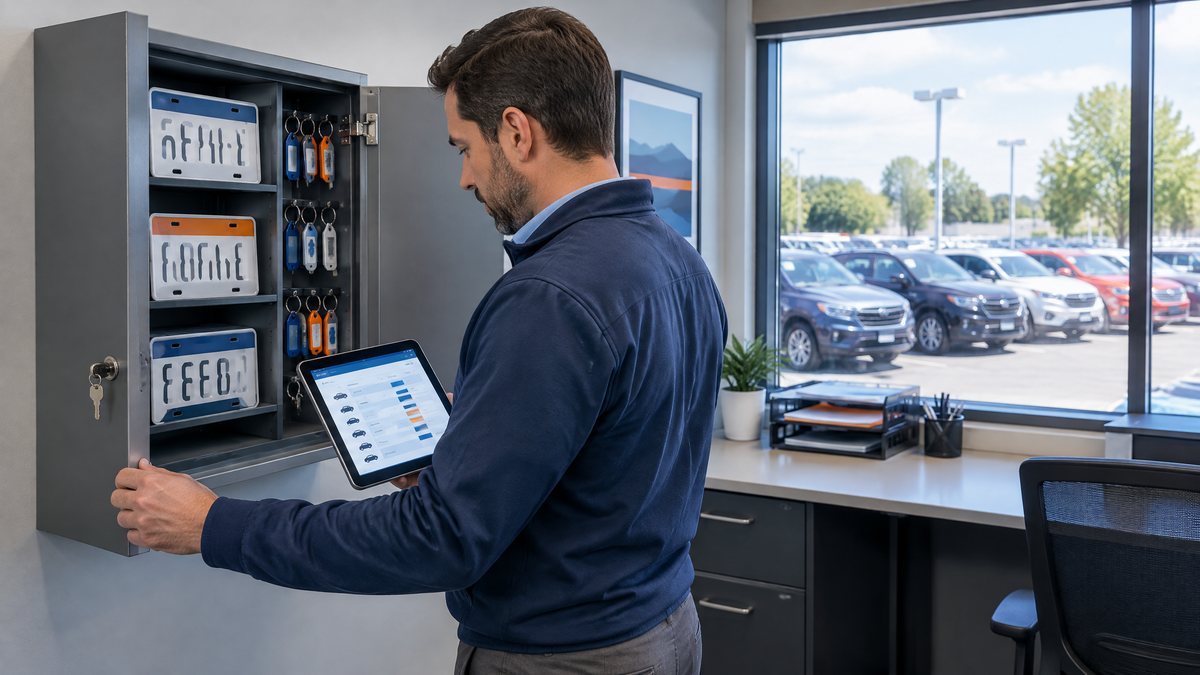
A workable control system does not need expensive software. It needs clear ownership, real-time records, secure storage, and consequences for bypassing the process.
Step 1: Assign a Plate Custodian
One manager should control issuance, returns, replacement requests, and daily reconciliation. If everyone has authority, no one has accountability.
Step 2: Maintain a Live Plate Log
The log should record plate number, date and time out, VIN, year/make/model, driver’s full name, driver’s license verification, business purpose, destination or authorized route, expected return, actual return, and approving employee. Texas expressly requires core plate, vehicle, VIN, and operator information.[2]
Step 3: Use Written Authorization
Customer demonstrations, loaners, transports, and employee demonstrators should have the state-required certificate or a written authorization that supplements it. The form should identify the vehicle and plate, limit the purpose and duration, require lawful operation, prohibit unauthorized drivers, and state the accident-reporting procedure.
Step 4: Lock Plates When Not in Use
Remove plates from unattended vehicles. Store them in a locked cabinet, key-management system, or restricted room. Marsh specifically recommends locked storage, formal tracking, and a daily audit.[5]
Step 5: Screen Drivers
Inspect and record a valid license before every customer use. Run MVRs on employees and recurring drivers in accordance with applicable law. Send the regular-driver list to the insurance agent and confirm that no one is excluded.
Step 6: Separate Inventory Use From Operational Use
Use the registration and commercial auto arrangement required for the vehicle’s actual function, whether it is a tow truck, parts vehicle, delivery unit, rental, or another service vehicle. Do not assume dealer ownership alone makes an operating vehicle eligible for a dealer plate.
Step 7: Reconcile Plates Daily
At closing, every plate should be physically present or tied to an approved open assignment. A missing plate should trigger immediate internal escalation and the reporting or cancellation steps required by the issuing state. Suspected theft should be reported to law enforcement. Texas, for example, directs license holders to cancel lost or stolen plates in eLICENSING and report stolen plates to local law enforcement.[2]
Step 8: Review the Program Before Renewal
Before insurance and dealer-license renewal, compare the plate list, vehicle-use practices, employee list, demonstrators, locations, and actual operations against the policy application. Disclose changes. Undisclosed drivers, uses, locations, or operations can affect eligibility, pricing, and how a claim is handled.
What to Ask Your Insurance Agent
A dealer-plate review should produce direct answers, not vague assurances. Ask whether liability applies to every plate and every qualifying inventory vehicle; who qualifies as an insured; whether customers, contractors, household members, and employees are treated differently; whether any drivers are excluded; how employee demonstrators are rated; whether personal use is allowed; what territory and radius apply; whether auction transport is covered; whether customer loaners are covered; and which policy protects physical damage to the dealer’s own vehicle.
Also ask whether the umbrella schedules and follows the relevant garage auto exposure and whether open lot physical damage applies while inventory is being driven. Request the controlling policy provisions or written clarification from the agent or carrier. A certificate of insurance is evidence of the coverage represented on the date it is issued; it does not amend the policy, confer rights, or summarize every exclusion, condition, or endorsement.
Frequently Asked Questions About Dealer Plate Insurance
Is dealer plate insurance a separate policy?
Does insurance follow the dealer plate or the vehicle?
Can a customer drive a car with dealer plates?
Can an employee use a dealer-plated car as a personal vehicle?
Are dealer plates covered on customer vehicles?
What happens if a dealer plate is stolen?
How many dealer plates should a dealership carry?
The Bottom Line
Dealer plates are valuable business tools, but each plate is also a portable liability exposure. The strongest dealership program combines four elements: a state-compliant license and plate structure, garage or business auto liability that matches actual operations, physical-damage protection for inventory, and a documented plate-control process that employees follow every day.
Do not wait for a serious accident or regulator audit to discover that a driver, vehicle, or use was outside the rules. Review your plate count, driver list, demo assignments, log, and policy now. DealerLiability.com has access to 100+ A-rated carriers overall and can help compare coverage terms—not merely the premium. Start an instant dealer insurance quote.
Official Sources and Industry Guidance
Source hierarchy: The cited state statutes and motor-vehicle agency pages control the legal summaries for their jurisdictions. Victor Insurance and Marsh Risk Advisory are cited only for general underwriting and plate-control practices; they do not override state law or the terms of an issued insurance policy.
- Victor Insurance — Garage Liability Underwriting Guidance (industry source)
- Texas Department of Motor Vehicles — Dealer License Plates
- Georgia Department of Revenue — Dealer Registration and Plate Guidelines
- North Carolina General Statutes § 20-79 — Dealer License Plates
- Marsh Risk Advisory — Dealer Plate Control Recommendations (industry source)
- Virginia Code, Title 46.2, Chapter 15, Article 5 — Dealer's License Plates
- South Carolina DMV — Dealer License Plates
- 2026 Florida Statutes § 320.27 — Motor Vehicle Dealers
- 2026 Florida Statutes § 320.13 — Dealer and Manufacturer License Plates
Insurance and legal disclaimer: This article provides general educational information, not legal advice, a coverage opinion, or a binder of insurance. State summaries are selective and may not address every license class, plate type, exception, or local procedure. Dealer-plate rules, insurance requirements, forms, and penalties change and vary by jurisdiction. No coverage is guaranteed; coverage is controlled exclusively by the issued policy, endorsements, facts of the loss, and applicable law. Verify current requirements with the issuing state agency and review actual policy language with a licensed insurance professional before acting. Information last verified September 21, 2026.

Kevin A. Smith
Kevin specializes in commercial insurance for automotive businesses — dealers, repair shops, towing companies, and garages — across FL, TX, GA, NC, SC, OK, NM, and UT. He works with 100+ A-rated carriers to find the right coverage at the right price.
View all articles by Kevin