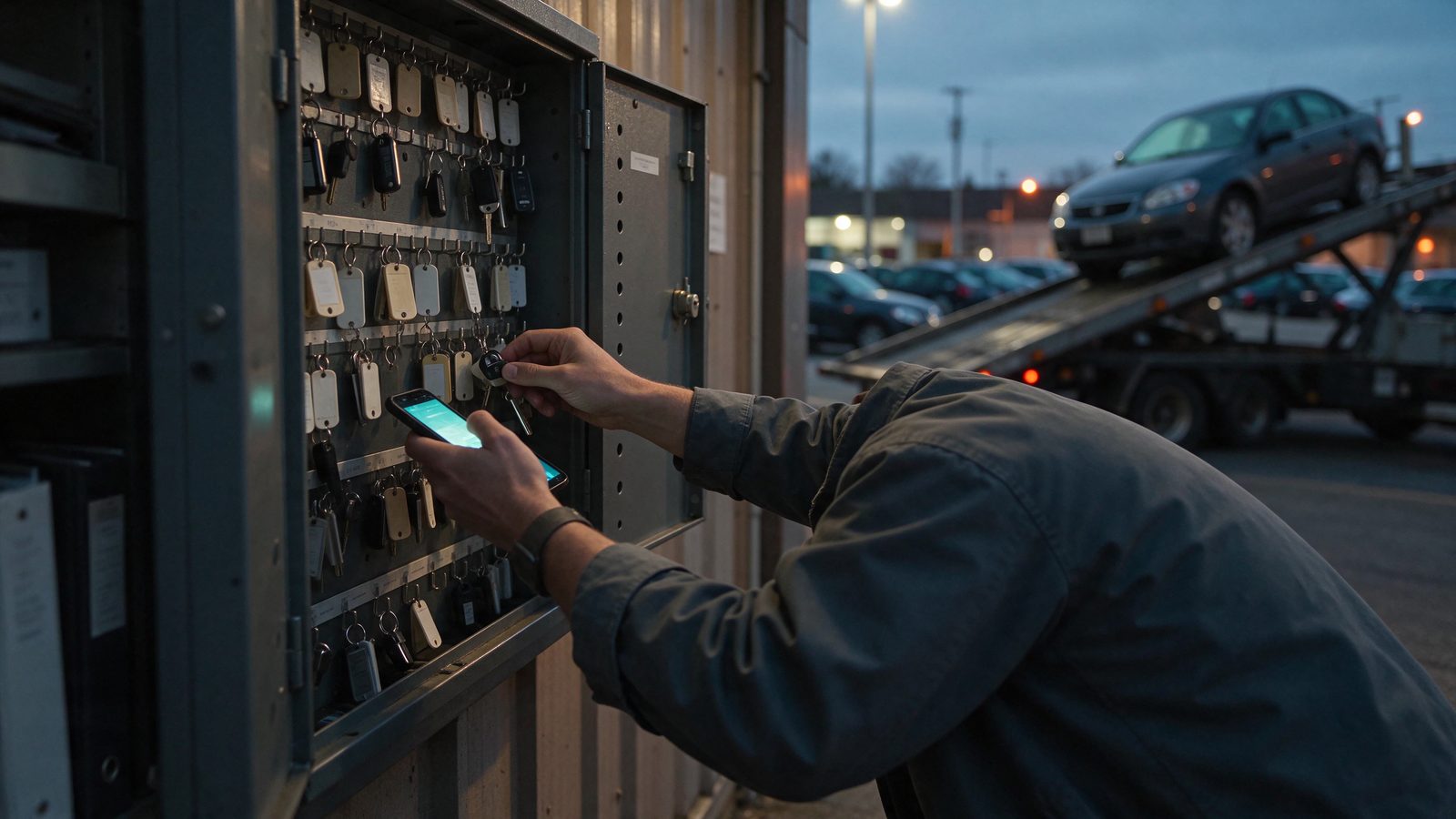
The thief who costs a used car dealer the most in 2026 often does not break a window. A fob gets swapped during a demo. A key walks out of an unlocked drawer. A "transporter" with a clean-looking certificate drives your sold unit somewhere the buyer never sees it. We went through dealer forums, Reddit threads, Facebook posts, trade association alerts, and carrier risk guidance to build this playbook. It covers key and fob custody, after-hours lot controls, how to verify a car hauler before you release a vehicle, and the insurance questions that decide who pays when a car disappears.
- What dealers are reporting
- Key and fob custody that staff will actually follow
- After-hours lot controls
- How transport fraud and double brokering work
- A transporter verification protocol
- Remote buyers and out-of-state delivery
- Which insurance responds
- The first hour after a theft or diversion
- Key fob theft and transport fraud FAQs
What dealers are reporting
National vehicle theft is falling. The National Insurance Crime Bureau reported 268,415 vehicle thefts in the first half of 2026, down 21% from a year earlier, with Florida down 31%. NICB also warned that "a wide range of other vehicle-related crimes and fraudulent schemes continue to rise."[1] Dealer inventory sits squarely in that second group.
Insurance specialists at Ally, which insures franchised dealers, told CBT News in March 2026 that false pretense claims and cargo theft are now the most common vulnerabilities they see, while lot theft has tapered but remains a concern. "Cargo theft is on the rise across the industry," they said.[2] Organized crews have not gone away either. In July 2026, NIADA reported on a federal case against a ring that took at least 82 vehicles worth nearly $5.9 million from luxury dealerships in 14 states between 2021 and 2023. Its members posed as test-drive customers, "switched key fobs, stole keys from lock-boxes," and broke in. NIADA noted that independent dealers "have long flagged key fob theft as a growing vulnerability."[3]
Dealers describe the same patterns in their own words. These are individual, anecdotal accounts, not statistics:
- An employee at a franchise store posted on Reddit that six vehicles were stolen in one week. Thieves were caught on camera working midday with a laptop while "the keys were obviously still inside the key machine."[4] Locked keys alone did not stop it.
- A dealer-side commenter on Reddit described a Corvette stolen with a cloned key while "the key was on the managers desk about 25 feet from the car."[5]
- In October 2026, WDRB News in Louisville posted about a local dealer "fed up with thieves taking off with his cars."[6]
- A used-lot employee on Reddit said keys went missing often enough that it was "getting expensive," and that a sign-out sheet worked "maybe for a week" before staff stopped using it.[7]
Key and fob custody that staff will actually follow
Most key problems are discipline problems, not hardware problems. On DealerRefresh, a long-running thread about dealership key systems shows the same issues for 16 years. One store had "a HUGE issue w/ lost keys." Another user warned that if the lockbox battery dies or there is a "glitch," you cannot get the keys out, which is hard when a used car has only one key. A vendor described lot staff defeating a box that would not close without keys by putting pennies in the slots. As recently as July 2026, a user reported "15+ minute delays" getting into a key system.[8] An expensive cabinet does not help if staff work around it.
A custody system that holds up has five parts:
- Count keys at intake. Record how many keys and fobs came with each unit when you acquire it. If you never knew a car came with two fobs, you will never notice that one is missing.
- Separate spares from primaries. Keep second keys in a different locked location from the working set, with access limited to managers. A thief who gets into one box should not get both keys.
- One key out per customer, logged to a person. Every sign-out records the stock number, the employee, the time out, and the time back. Use stock numbers on key tags instead of year, make, and model so a lost key does not advertise which car it opens.
- Verify the key that comes back. Fob swapping works because nobody tests the returned key. Before any key goes back in the box, confirm it operates that vehicle, the same return check our unaccompanied test-drive guide recommends.
- Reconcile at open and close. Count keys against the inventory list at the start and end of every day. A missing key gets investigated that day, and the vehicle gets moved, immobilized, or watched until the key is found or rekeyed.
Plan for the system failing. If your electronic cabinet goes down, staff will improvise. Write the fallback now: a paper log kept by the manager on duty, a sealed override key, and a rule that the system outage gets reported the same day.
| Key log field | Why it matters after a loss |
|---|---|
| Stock number and VIN | Ties the key to a specific unit for police and claim reports |
| Keys and fobs at intake | Shows whether a second fob was missing before the theft |
| Employee who signed it out | Lets you reconstruct who had access and when |
| Time out and time back | Identifies the window when a swap or copy could have happened |
| Return check done (yes/no) | Proves the returned key operated the vehicle |
| Opening and closing count | Shows you reconcile daily, which an adjuster or underwriter may ask about |
After-hours lot controls
Ally's specialists recommend an organized key system, staff who know where keys and vehicles are at all times, GPS and geofencing that alerts you immediately when a car leaves, and blocked entrances and exits.[2] Zurich's 2026 catalytic converter guidance for dealers adds a practical lot checklist that works against whole-vehicle theft too:[9]
- Park vehicles in well-lit areas with after-hours traffic, and put high-clearance trucks and SUVs in the most secure, visible spots, with lower vehicles parked around them.
- Avoid off-premises lots unless security is present.
- Run after-hours perimeter inspections, alarm fenced storage areas, and use video with motion sensors and live monitoring.
- Inspect inventory regularly for tampering, and investigate cut exhaust pipes or partial theft attempts right away.
- Write a detailed lock-up procedure for doors, gates, and fences, and a way for staff to report suspicious activity.
Simple barriers get a lot of dealer support. In the same Reddit lot-theft thread, a franchise store employee called the locking gates at their entrances "the best theft deterrent we have for inventory cars."[4] For a small independent lot, a vehicle or bollard parked across the exit at close can do much of the same job.
How transport fraud and double brokering work
When you sell to an out-of-state buyer or move units between locations, the riskiest moment is the handoff to a carrier you have never met. Ally's specialists describe the usual sequence. Most cargo theft starts when a dealer lists a vehicle on an online shipping load board. After the buyer agrees and shipping terms are set, criminals step in through a fictitious broker or a hacked legitimate shipping account. They intercept the vehicle and then double-broker it, passing it to an unsuspecting legitimate carrier or to a shipper inside their own organization.[2]
The Federal Motor Carrier Safety Administration describes the federal side of the same problem. It treats using another carrier's USDOT number without authorization, or acting as a broker without FMCSA registration, as fraud and identity theft. FMCSA warns that top search results may be fake profiles and that "even insurance certificates can be fraudulent."[10] Fake carriers are good at paperwork. The paperwork alone is not proof.
Dealers sometimes get the details for a transporter from the buyer, from a broker, or from an email that arrives after the deal closes. Every one of those channels can be spoofed. Verification has to happen outside the channel the request came through.
A transporter verification protocol
This protocol combines FMCSA's anti-fraud guidance with the pre-release steps Ally's specialists recommend.[10][2] Use it every time, including for carriers you have used before, because hacked accounts can look exactly like your regular hauler.
| Step | What to do | Stop release if |
|---|---|---|
| 1. Look up the carrier | Search the USDOT or MC number on FMCSA's SAFER system (safer.fmcsa.dot.gov). Research the company outside the load board and confirm a legitimate online presence. | The name, address, or authority in SAFER does not match what you were given |
| 2. Call the SAFER number | Call the phone number listed in SAFER, not the one in the email or posting, to confirm the booking. | The numbers differ and the SAFER contact cannot confirm the job, or SAFER lists no phone |
| 3. Confirm the certificate | Get the certificate of insurance and confirm with the issuing insurance company that the policy is active. | The insurer cannot confirm the policy or the named carrier |
| 4. Confirm with the buyer | Using contact details from the deal file, confirm the pickup time, the transport company name, and the original shipping terms. | Any of the three changed by text or email without a call you placed |
| 5. Match the truck | Check that the company name and numbers on the truck match the carrier you booked. Photograph the tractor and trailer and record both plate numbers. | The truck shows a different name or number, or the driver cannot explain the mismatch |
| 6. Track the load | Use real-time tracking where available, and confirm delivery with the buyer directly. | Tracking goes dark or the route makes no sense |
FMCSA also lists warning signs aimed at carriers being recruited into fraud: a "blind load," a broker who is quick to pay more, a rate far above market, or a request to present under a different company name.[10] From the dealer's side, the mirror images are a quote far below market, a carrier who wants to come early or switch drivers at the last minute, and a request to change the delivery address after the sale. Any of them is reason to pause and re-verify.
If a vehicle is diverted, FMCSA lists these reporting channels: local police and your state attorney general, the FTC at reportfraud.ftc.gov, the FBI's Internet Crime Complaint Center (IC3), the FMCSA Contact Center at 1-800-832-5660, the U.S. DOT Office of Inspector General hotline at 800-424-9071, and FMCSA's National Consumer Complaint Database at nccdb.fmcsa.dot.gov.[10]
Remote buyers and out-of-state delivery
Remote delivery puts a buyer you have never met at one end and a carrier you have never met at the other. Dealer surveys suggest how often that goes wrong. In Experian's 2026 dealer fraud survey, dealers reported completing about four fraudulent deals on average in the prior 12 months before catching them, and 64% said insurance covers less than half of their fraud costs.[11] An eLEND survey found nearly 80% of dealers had seen fraud-related activity grow over the past 24 months.[12] Both are vendor surveys of mixed dealer groups, so treat them as direction rather than precise rates.
The firsthand accounts are blunt. On DealerRefresh, a dealership respondent described a roughly $70,000 Challenger loss: "All the proper docs were signed and returned. Everything was done by the book. We delivered the car to Atlanta. It's never been seen since."[13] In a 2024 TIADA case, a San Antonio independent dealer released a vehicle after an online application and credit check. Police would not treat it as a stolen car "because she handed the keys to the customer," and pointed the dealer toward a fraud claim instead.[14]
Our false pretense coverage guide covers buyer identity and payment checks. For the delivery itself, add three rules. The person who signs for the vehicle at delivery must match the buyer you verified. Nobody changes a delivery address after funding without a callback to a number from the original deal file. And proof of delivery, meaning a signature, an ID check, and a photo at drop-off, comes back to you before the deal is closed out.
Which insurance responds
When a car disappears, the facts decide which part of your program responds, and some answers may surprise you. This is general education. Your policy wording controls.
Theft from the lot. A break-in or a car driven off your lot overnight is usually a physical damage claim under your dealers open lot or inventory coverage. Deductibles, theft conditions, and any security or key-storage requirements in your policy apply. Zurich notes that many policies now carry higher per-vehicle deductibles and per-occurrence deductible aggregates, so dealers "may end up paying the full cost of replacement until they meet their aggregate amount."[9] That is why repeated catalytic converter thefts can feel uninsured.
A trick or a fake transporter. When you hand over a vehicle voluntarily because someone deceived you, many garage physical damage forms exclude the loss. IRMI's insurance glossary describes the false pretense exclusion with two examples that fit this article exactly: "a customer absconding with an automobile on the pretense of test-driving it" and a dealer "instructed to deliver it to the wrong party because of fraudulent instructions." IRMI explains that a false pretense endorsement can restore that coverage.[15] This exclusion has a long history. In a 1951 North Carolina case, the state's supreme court upheld a voluntary-parting exclusion after a dealer's sales manager let a stranger take a car to test it, while noting that other courts had reached the opposite result under the same wording.[16] That case is historical, but the question it raised still comes up.
Identity fraud and the paperwork fight. Even with fraud coverage, documentation can become the battle. In a lawsuit filed in March 2026, a Louisiana franchise dealership alleged that a buyer used a stolen identity and forged signatures to drive off in a truck under a $102,457 installment contract. Its floor plan policy had a $150,000 "Extended Theft" limit. The dealer alleges the insurer denied the claim, saying the incident needed to be reported to law enforcement "as a theft," then made repeated demands for police reports, and "CBG contends no such requirement exists in the policy." No court had ruled and the insurer had not yet responded when the case was reported.[17] The allegations are unproven. The lesson still holds: know what documents your fraud coverage requires before you need them.
Ask your agent these questions, in writing:
- Do I have false pretense coverage, and what is the limit per vehicle and per year?
- Does it cover a vehicle released to a fraudulent transporter, or only a fraudulent buyer?
- Are my vehicles covered while in transit with a third-party carrier, and who bears that risk under my shipping terms?
- Does my policy have key-storage, security, or after-hours conditions for theft claims?
- What are my per-vehicle and per-occurrence theft deductibles, and is there an annual aggregate?
- Are all my overnight locations listed?
- What documents, including police reports, does the policy require for a theft or fraud claim?
The first hour after a theft or diversion
What you do in the first hour shapes the police report, the recovery odds, and the claim file. Lot theft and transport diversion need different first moves.
| First-hour step | Lot theft or break-in | Transport diversion |
|---|---|---|
| Locate | Call your GPS or telematics provider for a location | Call the carrier at its SAFER-listed number, then the buyer at the deal-file number |
| Report | Police report with VIN, stock number, plate, and key status | Police report, plus the FMCSA and fraud channels listed above |
| Preserve | Export camera footage before it records over, and photograph the scene | Save the load board posting, emails, texts, the certificate, and pickup photos |
| Count | Run a full key count and inventory walk to find any other missing units or keys | Hold every other pending shipment with that carrier or broker |
| Notify | Your agent or carrier promptly under the policy's notice terms, and your floor plan lender if your agreement requires it | Same, and note whether the loss looks like theft, false pretense, or in-transit damage |
Write down the timeline while staff still remember it: who released the key or the vehicle, when, to whom, and on what instructions. Then rekey or reprogram any vehicle whose key is unaccounted for.
Find Out How Your Policy Handles Theft, Tricks, and Transit
Ellie Insurance Group has access to 100+ A-rated carrier markets (AM Best A- or higher) and holds a 5-star Trusted Choice agency rating. Send us your declarations, and we will show you how your dealers open lot, false pretense, and garage coverages respond to lot theft and fraud, and compare eligible options.
Related reading: the 7 biggest insurance mistakes used car dealers make, dealers open lot coverage explained, and dealers open lot insurance.
Key fob theft and transport fraud FAQs
Does dealer insurance cover a car taken by a fake transporter?
It depends on your policy. A car you hand to a fraudulent carrier is often treated as a voluntary parting caused by a trick, not ordinary theft. IRMI's glossary gives a dealer delivering a vehicle to the wrong party because of fraudulent instructions as an example of the false pretense exclusion, which a false pretense endorsement can restore. Check whether you carry that endorsement, its limit, and whether it applies to transport fraud.[15]
How do I verify a car transporter before releasing a vehicle?
Look up the carrier's USDOT or MC number on FMCSA's SAFER system and call the phone number listed there. Confirm the certificate of insurance with the issuing insurer. Confirm the pickup time, company name, and shipping terms with the buyer. At pickup, match the name and numbers on the truck to the carrier you booked, photograph the truck and trailer, and record both plates.[10][2]
What is double brokering in vehicle shipping?
Criminals intercept a shipment through a fictitious broker or a hacked legitimate shipping account, then pass the load to another carrier, which may be an unsuspecting legitimate company or part of the criminal group. According to Ally's insurance specialists, most of this cargo theft begins after a dealer posts a vehicle on an online load board.[2]
Is a vehicle stolen from my lot with a copied key covered?
Theft from your lot is usually a physical damage question under your dealers open lot or inventory coverage, subject to your deductibles and any theft or key-storage conditions in the policy. If staff handed over the key because someone deceived them, the false pretense exclusion may come into play instead. Ask your agent how your policy treats both situations.[15]
How often should a dealership count its keys?
At least twice a day, at opening and at close, against the inventory list. Ally's specialists recommend that staff know where keys and vehicles are at all times. Investigate a missing key the same day, and move, immobilize, or rekey that vehicle until the key is found.[2]
Why did I pay for most of my catalytic converter thefts myself?
Many policies now carry higher per-vehicle deductibles and per-occurrence deductible aggregates. Zurich notes that insureds may end up paying the full cost of replacement until they meet their aggregate. Ask your agent for your theft deductible, any aggregate, and how partial thefts are handled.[9]
Who should I report a diverted vehicle shipment to?
Start with local police. FMCSA also lists the FTC at reportfraud.ftc.gov, the FBI's IC3, the FMCSA Contact Center at 1-800-832-5660, the U.S. DOT Inspector General hotline at 800-424-9071, and the National Consumer Complaint Database. Notify your insurance agent or carrier promptly as well.[10]
Sources and references
Government guidance and insurer publications are cited as published. Reddit, forum, and Facebook posts are individual accounts and are labeled as anecdotal. Franchise dealer examples and older cases are labeled as such. Your policy's terms control coverage.
- NICB, U.S. Vehicle Thefts Fall 21% in First Half of 2026 (September 30, 2026)
- CBT News, How Ally Dealership Insurance can help dealers protect their inventory from theft and fraud (March 12, 2026)
- NIADA Dashboard, Sophisticated Multi-State Auto Theft Ring Targeted Dealerships (July 21, 2026)
- Reddit r/askcarsales, Anyone else dealing with theft on their lots? (November 20, 2021), anecdotal forum post from a franchise store
- Reddit r/askcarsales, Are car thefts a serious problem for dealerships? (August 23, 2024), anecdotal forum post
- WDRB News Facebook post on a local dealer's repeated vehicle thefts (October 29, 2026)
- Reddit r/techsupport, Lost car keys at dealership becoming problematic (July 25, 2014), anecdotal forum post
- DealerRefresh forum, Key Systems for Car Dealers (2010 to 2026), anecdotal forum thread
- Zurich North America, Catalytic converter theft: Gone in 30 seconds (2026)
- FMCSA, Broker and Carrier Fraud and Identity Theft (updated April 7, 2025)
- Auto Finance Journal, Experian: Nearly 9 in 10 dealers now concerned about fraud (February 9, 2026)
- Auto Finance Journal, eLEND survey on dealer fraud activity (February 11, 2026)
- DealerRefresh forum, dealership identity-fraud and remote-delivery thread (2018), anecdotal forum post
- TIADA, San Antonio Dealer Falls Victim to Identity Theft in Fraudulent Vehicle Purchase (May 1, 2024)
- IRMI, False Pretense, Trick, and Device (insurance definition)
- McDowell Motor Co. v. New York Underwriters Ins. Co. (N.C. 1951), historical illustration
- Insurance Business, Zurich faces bad faith suit after alleged silence on dealer's claim (March 11, 2026), allegations not yet decided
Insurance and legal disclaimer: This article is general education for motor vehicle dealers, not legal advice or a promise of coverage. Whether a theft, fraud, or in-transit loss is covered depends on your issued policy, endorsements, exclusions, conditions, and the facts of the loss. Lawsuit descriptions summarize allegations as reported, not findings. Dealer forum and social media posts describe individual experiences and may not be typical. Confirm requirements with your carrier, an attorney, and a licensed insurance professional. Sources reviewed November 23, 2026.

Kevin A. Smith
Kevin specializes in commercial insurance for automotive businesses — dealers, repair shops, towing companies, and garages — across FL, TX, GA, NC, SC, OK, NM, and UT. He works with 100+ A-rated carriers to find the right coverage at the right price.
View all articles by Kevin