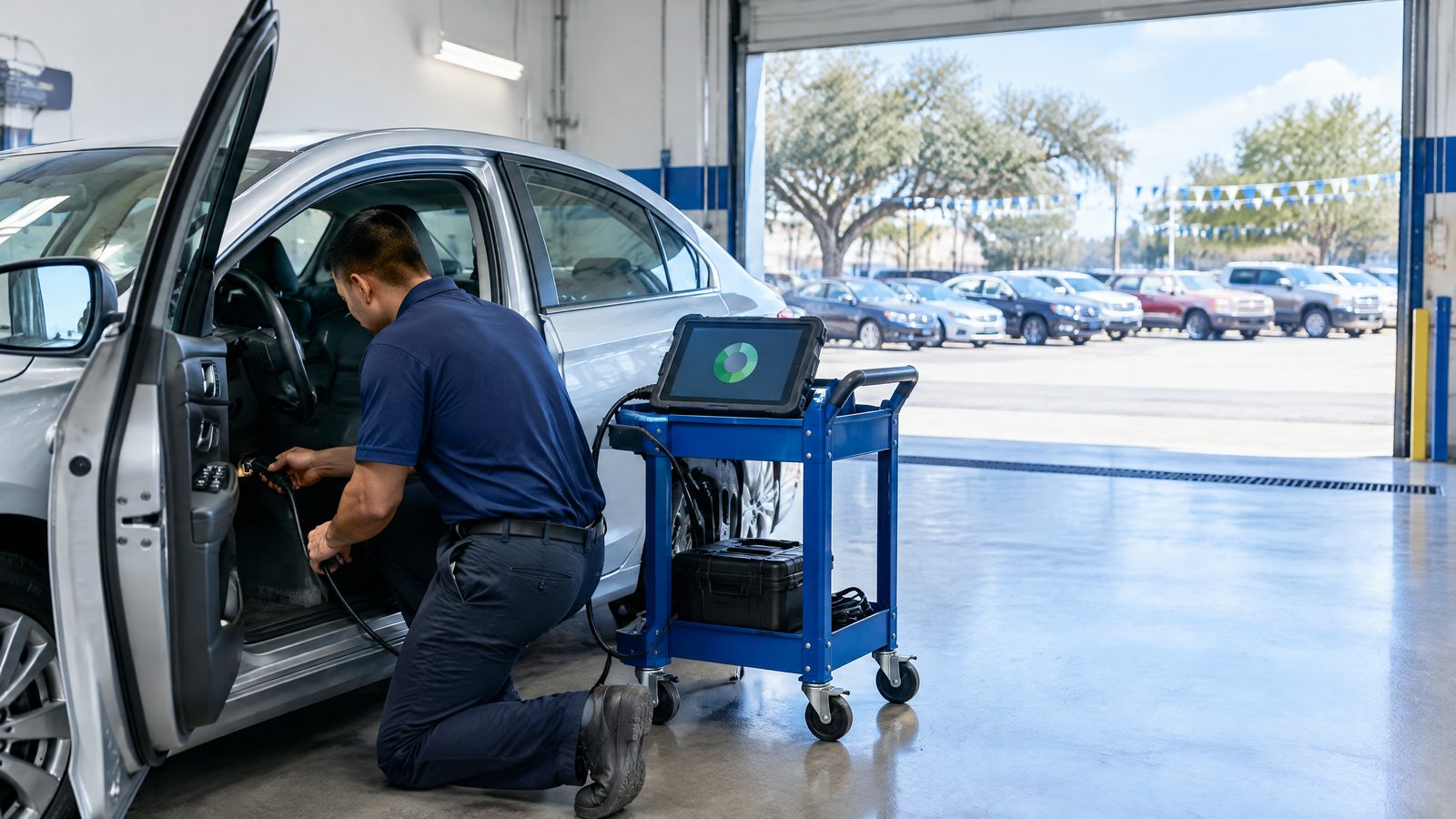
If you sell used vehicles in San Antonio or anywhere in Bexar County, November 1, 2026 changed your sales checklist. Bexar County is now a Texas emissions county. That means many retail sales to Bexar County buyers once again need a passing emissions inspection, and an inspection station cannot pass a vehicle unless someone shows proof of auto liability insurance for it.
Many dealers are hearing a simplified version: "Texas now requires garage liability insurance." The real rule is more specific, and knowing it can save you a rejected title transaction, a delayed delivery, or a car that cannot be tested. This guide explains what changed, which counties and sales are affected, why the inspection is where insurance shows up, and how to make sure your Texas dealer insurance works when a porter drives an inventory vehicle to the station.
- What changed on November 1, 2026
- Is garage liability a GDN requirement?
- When a used vehicle needs a test before sale
- The 18 Texas emissions counties
- Why stations ask for insurance
- Insurance proof for dealer inventory
- Timeline of the changes
- Bexar County dealer checklist
- Dealers outside emissions counties
- Texas dealer emissions FAQs
What changed for Texas dealers on November 1, 2026?
On November 1, 2026, Bexar County emissions testing began. The Texas Department of Motor Vehicles (TxDMV) told county tax offices and dealers that, starting that date, gasoline-powered vehicles 2 through 24 years old registered in Bexar County need an emissions inspection. It also told dealers to follow the existing emissions-county procedures for Bexar County residents.[5][6] The Texas Commission on Environmental Quality (TCEQ) lists Bexar County's program start as November 1, 2026.[7]
That matters because of a change Texas made at the start of 2025. House Bill 3297 ended annual safety inspections for most non-commercial vehicles on January 1, 2025. Emissions testing continued only in emissions counties, and commercial vehicles still need safety inspections.[10] In practice, a San Antonio dealer selling a non-commercial used car between January 2025 and October 2026 usually had no pre-sale inspection to complete. Now, a sale to a Bexar County buyer, or to a buyer who lives in another emissions county, generally brings the inspection back. With it comes the insurance check at the station.
For Bexar County, TxDMV lists an $18.50 fee paid to the inspection station at the time of the test and a $2.75 state emissions fee collected at registration. Bexar County stations were not allowed to run emissions tests before November 1, 2026.[5]
Does Texas now require garage liability insurance for a dealer license?
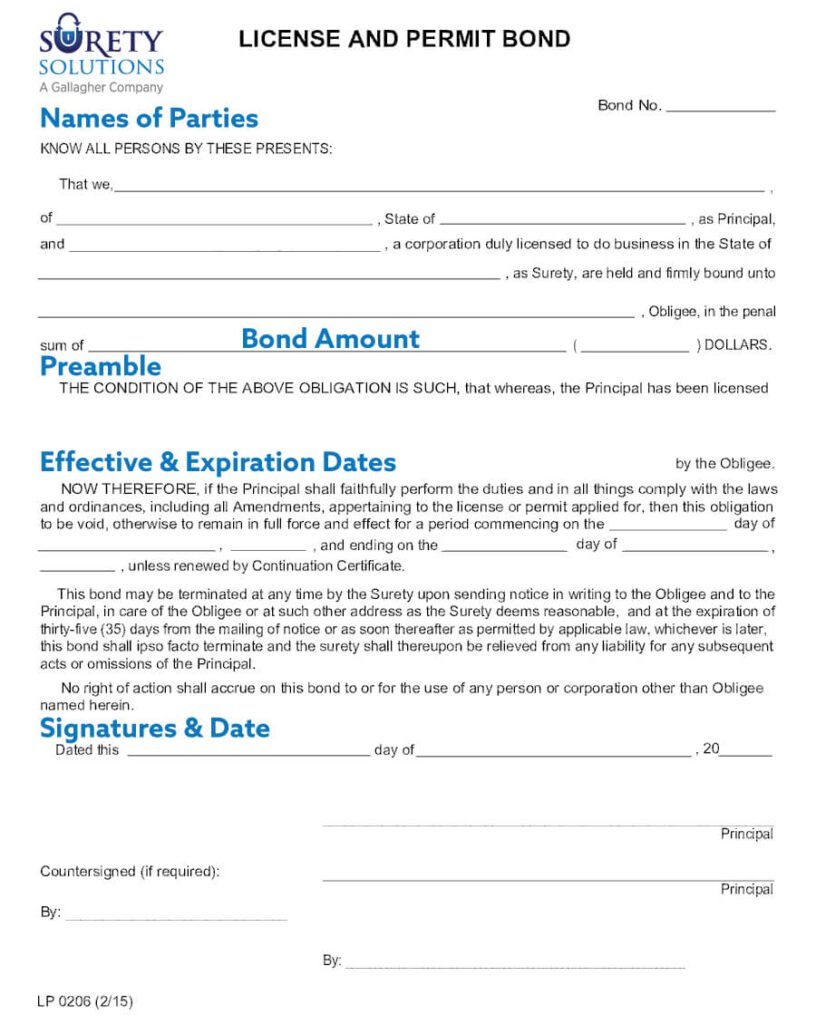
No. For an ordinary independent (used) retail dealer, Texas has not made garage liability insurance a condition of the General Distinguishing Number (GDN). The Texas Transportation Code says TxDMV may not issue or renew a motor vehicle dealer GDN unless the applicant proves it has a $50,000 surety bond.[3] The bond amount rose from $25,000 to $50,000 on September 1, 2021.[20] TxDMV's current Retail GDN checklist (Form LG100, revised August 2026) asks for the signed $50,000 bond, a licensing-education certificate, and premises documents. It does not list an insurance certificate.[4]
There is one narrow licensing exception. An independent mobility motor vehicle dealer, a dealer that modifies vehicles for people with disabilities, must show garagekeepers coverage of at least $50,000 and products-completed operations coverage of at least $1 million.[3] That rule does not apply to a typical used-car lot.
So where do the "garage insurance" stories come from? Texas law has always required financial responsibility to operate a motor vehicle.[2] That rule covers dealers when employees move inventory, customers take test drives, or a porter drives a car to an inspection station. The emissions inspection is simply the point where a missing dealer auto-liability policy gets noticed. The inspection does not create a new license requirement. It enforces an insurance rule that already applied.
| Question | Verified answer for a Texas retail used dealer |
|---|---|
| Dealer bond required for the GDN? | Yes: $50,000 surety bond[3] |
| Garage liability certificate required for the GDN? | Not on TxDMV's Retail GDN checklist; no general Chapter 503 requirement[3][4] |
| Auto liability needed to drive inventory on Texas roads? | Yes: financial responsibility is required to operate a motor vehicle[2] |
| Insurance proof needed to pass an emissions inspection? | Yes: the owner or operator must furnish it at the time of inspection[1][12] |
| Insurance proof needed when the dealer files title and registration for the buyer? | No: TxDMV says licensed dealers do not have to provide it for that filing[11] |
When does a used vehicle need an emissions inspection before a retail sale?
State law requires a used motor vehicle sold by a dealer to pass any required inspection during the 180 days before the date the dealer sells it.[1] For non-commercial vehicles, the only inspection still required is the emissions test, and only where it applies. TxDMV uses a two-part test: where the dealer is located, and where the buyer lives.[5][8][11]
| Dealer location | Buyer's county of residence | Emissions test required for the retail sale? |
|---|---|---|
| Emissions county | Emissions county | Yes, a passing test within 180 days before the sale unless the vehicle is exempt |
| Emissions county | Non-emissions county | No |
| Non-emissions county | Emissions county | No at the dealer sale; the buyer handles testing when the registration is renewed |
| Non-emissions county | Non-emissions county | No |
TxDMV's February 2025 dealer guidance and its 2026 Bexar bulletin use this same framework. TxDMV also says county tax offices will return dealer title transactions that lack a required passing emissions inspection.[5][8]
Common exemptions to check before you send a car for testing
- The resale exemption: a vehicle that is model year 1996 or newer, has fewer than 50,000 miles, and was last titled or registered in a non-emissions Texas county does not need the pre-sale test.[1][8]
- Out-of-state vehicles: a vehicle last titled in another state does not qualify for that exemption. TxDMV says it needs the test when an emissions-county dealer sells it to an emissions-county buyer.[8]
- Vehicle type and age: the emissions program applies to gasoline-powered vehicles 2 through 24 years old. TCEQ's program does not test diesel or electric vehicles or motorcycles.[5][7]
- Commercial vehicles: these still need a safety inspection, so they follow a different checklist.[10]
Which Texas counties require emissions testing in 2026?
As of November 1, 2026, Texas has 18 emissions counties.[7][21] If your dealership is in one of them, check the buyer's county of residence on every retail deal.
| Region | Emissions counties | Related local guide |
|---|---|---|
| San Antonio (new Nov. 1, 2026) | Bexar | San Antonio dealer insurance |
| Houston-Galveston-Brazoria | Brazoria, Fort Bend, Galveston, Harris, Montgomery | Houston dealer insurance |
| Dallas-Fort Worth | Collin, Dallas, Denton, Ellis, Johnson, Kaufman, Parker, Rockwall, Tarrant | Dallas, Fort Worth, Arlington |
| Austin-Round Rock | Travis, Williamson | Austin dealer insurance |
| El Paso | El Paso | El Paso dealer insurance |
The other 17 counties are not new to emissions testing. What changed for them came in early 2025: TxDMV's registration system started checking for a passing emissions inspection on dealer title applications on January 1, 2025, and TxDMV then issued dealer-specific guidance on February 10, 2025.[8][9] Bexar County is the newest county to come under those same rules.
Why does the emissions inspection station ask for proof of insurance?
This is the part of the process that catches bond-only dealers off guard. Texas Transportation Code Section 548.2521 says an inspection station or inspector may not issue a passing vehicle inspection report unless the vehicle's owner or operator furnishes evidence of financial responsibility at the time of inspection.[1] Before a retail sale, the owner is usually your dealership.
The Texas Department of Public Safety (DPS) inspection rules tell stations how to apply this rule:[12]
- A vehicle with no evidence of financial responsibility will be refused inspection, and no inspection fee is charged.
- A non-owner policy is not acceptable proof.
- Acceptable proof includes a liability policy at the legal minimums, the standard Texas proof-of-insurance card, an insurance binder, or an electronic image of the card on a phone.
- Proof for commercial fleet policies does not have to list each insured person or each vehicle's make and model.
DPS also lists "Insurance" as one of the items covered by an emissions inspection.[21] The Texas minimum limits for that proof are $30,000 per injured person, $60,000 per accident for bodily injury, and $25,000 for property damage.[2][12]
What insurance proof works for dealer-owned inventory?
Inventory changes every week, so a dealer policy usually does not list each vehicle by VIN. Texas insurance-card rules allow for that. When a policy does not schedule specific vehicles, the card can describe the covered vehicles by type, such as vehicles driven with dealer plates.[14] This is how the auto-liability portion of a garage liability or auto dealer policy is usually proven at the station.
A personal auto policy is generally the wrong tool. The standard Texas Personal Auto Policy excludes liability coverage while a person is employed or otherwise engaged in the business of selling, repairing, servicing, storing, or parking vehicles. That includes road testing and delivery. The exception is limited to the insured's own covered auto.[15] A personal card for the owner's family car is not a reliable way to test a car you are about to sell.
Texas also allows other ways to establish financial responsibility, such as a qualifying surety bond, a $55,000 cash or securities deposit with the Comptroller, or self-insurance for an owner with more than 25 registered vehicles.[2] Note that the $50,000 GDN dealer bond is not one of these. It protects buyers and others against problems such as title failures; it is not auto liability insurance.[3] For most independent dealers, a dealer auto-liability policy is the practical choice.
Need Dealer Auto Liability Before Your Next Emissions Test?
Ellie Insurance Group has access to 100+ A-rated carrier markets (AM Best A- or higher) and compares eligible garage and auto dealer programs for Texas dealers. Tell us your county, inventory, and who drives your vehicles, and we will look for coverage that fits how your lot operates.
How Texas got here: a timeline for dealers
| Date | What changed |
|---|---|
| Long-standing rule | Inspection stations may not issue a passing report without proof of financial responsibility.[1] |
| Mar. 1, 2016 | Under Two Steps, One Sticker, dealer-sold used vehicles needed a passing state inspection within 180 days before the sale. At the time, that included a statewide safety inspection.[19] |
| Sept. 1, 2021 | The Texas dealer bond rose from $25,000 to $50,000.[20] |
| Jan. 1, 2025 | HB 3297 ended safety inspections for non-commercial vehicles; emissions testing remained in 17 counties. TxDMV began system checks for emissions on dealer title transactions.[9][10] |
| Feb. 10, 2025 | TxDMV issued dealer guidance on the emissions resale exemption and the dealer-county/buyer-county rule.[8] |
| Sept.–Oct. 2026 | TxDMV announced Bexar County emissions requirements and sent dealer reminders.[5][6] |
| Nov. 1, 2026 | Bexar County emissions testing began, making Bexar the 18th emissions county.[7] |
What Bexar County dealers should do now
- Confirm the buyer's county of residence on every deal. Under TxDMV's dealer guidance, the buyer's residence and your location decide whether a test is required.[5]
- Track inspection dates. A required passing test must fall within the 180 days before the sale date.[1]
- Document exemptions. Record model year, mileage, and the county or state where the vehicle was last titled or registered.[8]
- Flag out-of-state trade-ins and auction buys. These generally need the test when both you and the buyer are in emissions counties.[8]
- Carry usable proof of insurance. Make sure your auto-liability proof covers dealer-owned vehicles. A non-owner policy will be refused.[12]
- Review who drives inventory. Porters, sales staff, and lot attendants driving to stations should be considered in your driver list and underwriting.
- Budget time and fees. Plan for the $18.50 Bexar station fee and possible failed-test repairs before delivery.[5]
- Check your dealer plates. TxDMV says vehicles operated with standard dealer plates need a current inspection. Its 2026 Dealer Manual lists emissions as required "if applicable" for standard dealer plates, but not for dealer temporary plates.[16][17] Our dealer plate insurance guide explains the insurance side.
Does this affect dealers outside emissions counties?
For a dealer located in a non-emissions county, a non-commercial used vehicle generally needs no pre-sale inspection, even if the buyer lives in an emissions county.[5][11] That does not remove your need for auto liability. Test drives, moving inventory, and dealer-plate use are still vehicle operation, and Texas requires financial responsibility to operate a motor vehicle.[2] Commercial vehicles also still need safety inspections.[10] For a deeper look at drive-related exposure, see our test drive liability insurance guide.
Coverage to review beyond the inspection
Passing the station's insurance check is the minimum. A policy that meets the 30/60/25 floor may still leave a dealership exposed after a serious test-drive accident or premises injury. When you review your Texas program, consider these coverages in addition to dealer auto liability:
- Garage liability limits sized to your sales volume, test-drive practices, and lender or auction requirements.
- Dealers open lot coverage for hail, theft, and other physical damage to inventory, which is especially important in Texas.
- Garagekeepers insurance if you hold customer vehicles for service, detail, or reconditioning.
- Your $50,000 Texas dealer surety bond, which must stay in force for the GDN.[3]
Our used car dealer insurance page and Texas garage liability guide cover these options in more detail.
Texas dealer emissions inspection and insurance FAQs
Does Texas require garage liability insurance to get a dealer license (GDN)?
Not for an ordinary retail independent dealer. The GDN requires a $50,000 surety bond, and TxDMV's Retail GDN checklist does not list an insurance certificate. Independent mobility dealers are the exception. Texas still requires auto liability to operate vehicles, and emissions inspection stations must see proof of it.[3][4]
When did Bexar County emissions testing start?
Do Texas dealers need an emissions test before selling a used car?
Only in certain sales. A non-commercial used vehicle generally needs a passing emissions test within 180 days before the sale when the dealer is in an emissions county and the buyer lives in an emissions county. Exemptions apply, including newer, low-mileage vehicles last titled in a non-emissions Texas county.[1][8]
Why does an emissions inspection require proof of insurance?
Can I use my personal auto insurance card to inspect inventory?
Generally not. The Texas Personal Auto Policy excludes liability while someone is engaged in the business of selling, repairing, servicing, storing, or parking vehicles, including road testing and delivery. Dealer inventory usually needs the auto-liability part of a garage or auto dealer policy.[15]
Does the dealer bond count as proof of insurance at the station?
Do I need garage liability insurance to become a DPS inspection station?
DPS's published station qualifications focus on facilities, equipment, certified inspectors, applications, and background checks. They do not list a garage-insurance requirement. A station that is also the seller of a vehicle may rely on an oral insurance binder. Dealers that inspect vehicles should still review garage liability and garagekeepers coverage for their operations.[1][13]
Sources and references
Statutes, agency guidance, and official forms control the rules in this article. Insurance policy terms control coverage.
- Texas Transportation Code, Chapter 548 — Sections 548.2521, 548.257, and 548.3011 (inspection insurance proof, 180-day dealer rule, resale exemption)
- Texas Transportation Code, Chapter 601 — Motor Vehicle Safety Responsibility Act (financial responsibility and 30/60/25 minimums)
- Texas Transportation Code, Chapter 503 — Sections 503.033 ($50,000 dealer bond) and 503.0295 (independent mobility dealers)
- TxDMV — Form LG100, Retail GDN Checklist: New Application Requirements (Rev. 08/26)
- TxDMV — RTB 003-26, Bexar County Emissions Testing Requirements (September 2026)
- TxDMV — Reminder: Bexar County Emissions Testing Requirements (October 2026)
- TCEQ — Vehicle Emissions Inspections in Texas (AirCheck Texas program overview)
- TxDMV — House Bill 3297 Emissions Exemption Update (Dealer), February 10, 2025
- TxDMV — RTS 25.1 County Release Notes (December 31, 2024)
- Texas DPS — Vehicle Safety Inspection Program Changes Now in Effect (January 3, 2025)
- TxDMV — Motor Vehicle Registration Manual (August 2026), Chapters 11 and 22
- Texas DPS — Vehicle Inspection Rules and Regulations Manual, Chapter 4, Section 04.10.0 (financial responsibility before inspection)
- Texas DPS — Inspection Station Qualifications
- 28 Texas Administrative Code Section 5.204 — Texas Liability Insurance Card
- Texas Personal Auto Policy (effective January 1, 2020), Part A Exclusions — TAIPA copy
- TxDMV — Dealer License Plates
- TxDMV — Motor Vehicle Dealer Manual (June 2026), dealer plate chart
- City of San Antonio — D9 Councilwoman Pushes for Emissions Testing Relief Amid Legal Hurdles (October 30, 2026)
- TxDMV — Dealer Guide to Two Steps, One Sticker
- Texas Legislature — HB 3533, 87th Legislature (2021), dealer bond increase
- Texas DPS — Inspection Criteria: Emission Inspection
Insurance and legal disclaimer: This guide is general education for Texas motor vehicle dealers, not legal advice or a binder of insurance coverage. Inspection, title, and registration rules can change, and county tax offices may apply them to specific facts. Your issued policy, endorsements, and exclusions govern coverage. Confirm requirements with TxDMV, DPS, TCEQ, your county tax office, and a licensed insurance professional. Sources reviewed November 16, 2026.

Kevin A. Smith
Kevin specializes in commercial insurance for automotive businesses — dealers, repair shops, towing companies, and garages — across FL, TX, GA, NC, SC, OK, NM, and UT. He works with 100+ A-rated carriers to find the right coverage at the right price.
View all articles by Kevin